
Fr Francesco Patton, OFM, reflects on the city of Nazareth.
By Fr Francesco Patton, OFM
Nazareth, (Natzrat in Hebrew and an-Nasira in Arabic), is a complex and fascinating city, nestled in the Hills of Galilee. With a population of close to 80,000, it holds the record of being the largest Arab city within the State of Israel. Its demographic composition reveals a unique religious richness: approximately one third of the population is Christian, composed of Greek Orthodox (who comprise about half), Latin Rite Catholics (Roman Catholics), Greek Melkites, Maronites, Copts, Anglicans and Lutherans. The local Latin parish church (dating back to 1620) is the most populous one in the Holy Land, numbering 9,000 parishioners. Unfortunately, in recent years, the local population has suffered due to crime and violence within the Arab-speaking community. This has led to public demonstrations against the shortage of police intervention in guaranteeing security in Arab-speaking communities.
From an urban planning perspective, Nazareth forms a single cluster with the predominantly Jewish modern city, Nof HaGalil, (Hebrew for “View of Galilee” and formerly known as Natzrat Illit, Upper Nazareth). Despite the rather chaotic urban development of the city, because of its significance in the economy of salvation, it continues to be the “pearl of Galilee”, as pilgrims from the Middle Ages referred to it (cf. H. Fürst — G. Geiger, Terra Santa: Guida francescana per pellegrini e viaggiatori, Terra Santa Edizioni, MI, 2018, pp. 119-142/1021).
The silence of the centuries and the beginning of the Gospel
It is interesting to note that Nazareth is completely absent from the pages of the Old Testament, as it is from writings by classical historians. This absence from sources suggests that in antiquity, the village had little relevance, prompting Nathanael, in the Gospel of John, to sceptically wonder: “Can anything good come out of Nazareth?” (Jn 1:46).
However, with the New Testament, the city forcefully entered into the universal history, and above all, into the history of salvation. As an ancient inscription opposite the altar in the Grotto of the Annunciation reads: “Here the Word was made flesh”. The miracle of God’s incarnation took place here, filling the infinite distance that separated him from us. Here, in the womb of the Virgin Mary, from the moment of Jesus’ conception, the fullness of divinity began to dwell in the flesh (cf. Col 2-9). Jesus spent most of the first 30 years of his earthly life, here, in “hiddenness”, at work in a peripheral, hardly known and slightly despised village. The Gospels of Luke, Matthew and Mark reveal some details of his daily life: his obedience to his parents (cf. Lk 2:51), his growth in wisdom, age and grace (cf. Lk 2:40, 52) and his manual work as the “son of a carpenter” (cf. Mt 13:55 and Mk 6:3). These 30 ordinary years consecrated every corner of the city as a sacred place: the place where the Son of God grew up, where he learned to read the Scriptures and to pray, where he learned to work. And all of this within a Jewish family in the first century, who introduced him to the traditions and the religiosity of his people, as thoroughly documented by Fr Frédéric Manns, OFM, (cf. F. Manns, L’ebreo di Nazaret, ETS, 2019).
The foundations of history: Archaeological evidence
A “reconstruction” of the ancient village was made possible thanks to archaeological investigations carried out in the 19th and 20th centuries, especially those by Br Benedict Vlaminck, OFM, (1892), Fr Prospero Viaud, OFM, (1907-1909), Fr Bellarmino Bagatti, OFM, (1955) and by Fr Eugenio Alliata, OFM, — generations of Friars Minor who served as archaeologists at the Studium Biblicum Franciscanum in Jerusalem. Their publications are the basis for the knowledge of the place from an archaeological perspective. At the time of Christ, Nazareth rose up from a hillside within a natural basin, precisely in the area that now overlooks the sanctuary and the Franciscan convent. Excavations uncovered a rural settlement that was typical of the time: stone houses, caves carved into the rock, internal stairways, water cisterns and grain silos. Although Nazareth is not mentioned in pre-Christian writings, ceramic findings indicate that the settlement was continuously inhabited from the second millennium B.C. (cf. https://www.custodia.org/it/santuari/nazaret-basilica-dellannunciazione/).
The Grotto of the Annunciation is located in the middle of this site. The first reports of [the existence of] a Church appeared late, around 570 AD, in a written account by a pilgrim from Piacenza: “The Holy House is a Basilica, and many graces are obtained there, thanks to [Mary’s] robes” (cf. Antonini Peregrini Itinerarium 5, in: Migne, PL, LXXII, col 901). The pilgrim of Piacenza adds interesting information regarding the women of Nazareth, who, he says, were considered the most beautiful, a beauty they attributed to being related to the Virgin Mary.
One century later (circa 670), another pilgrim, Frankish Bishop Arculf, provided further testimony when he wrote the following about Nazareth: “Two large churches were built here, one in the middle of the city, founded on two arches, where the house in which our Lord and Saviour was raised, once stood. The other church was built on the site of the house in which the Archangel Gabriel spoke to Blessed Mary, having found her on her own” (cf. Adamnano di Iona, De Locis Sanctis, II, 26, in: J. P. Migne, PL, LXXXVIII, col 801). However, archaeological data also revealed the presence of much older places of worship.
The Basilica of the Annunciation: A bridge between epochs
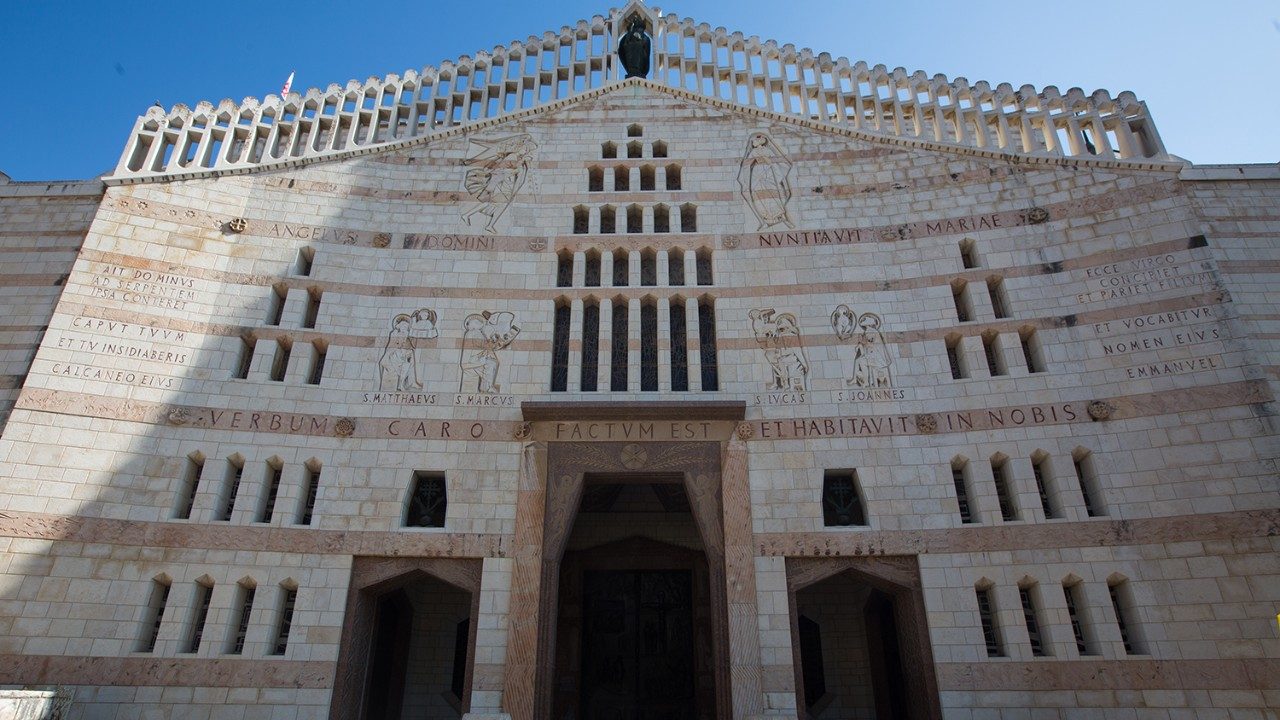
The current basilica was designed by the architect, Giovanni Muzio, and consecrated on 25 March 1969, on the Solemnity of the Annunciation, by Cardinal Gabriel-Marie Garrone. It is a monument that encapsulates 2,000 years of faith. Its reinforced concrete structure was conceived in the shape of an inverted lily, and acts as a treasure trove that contains earlier stratifications.
The beating heart of the sanctuary that houses the mystery of the Incarnation is located on the lower level. The church on this level is immersed in an atmosphere of dim lighting that inspires meditation, with the Grotto as its focus. Saint Francis described it as “the place in which Almighty Heavenly Father, through Saint Gabriel, His angel, announced the Word of the Father — so worthy, so holy and glorious — in the womb of the holy and glorious Virgin Mary, and from her womb received the true flesh of humanity and fragility” (cf. 2 Lf 4: FF 181). The remains of a Byzantine apse are visible here, and further down, a building used for worship, dating back to the fourth century: “Epiphanius of Salamis (circa 375 A.D.) wrote that, after receiving Baptism, Joseph of Tiberias, who had converted from Judaism, had built churches in his native town as well as in Sepphoris, Nazareth and Capernaum, also thanks to a contribution from the emperor” (H. Fürst — G. Geiger, op.cit., 123/991). One of the most valuable findings on exhibit in the museum is the base of a column with the Greek inscription of the beginning of the “Hail Mary” (in Greek “Xe Mapia”, that is, “Chaire Maria”, which means “Rejoice Mary (cf. Lk 1:28). It is the oldest archaeological testimony of the Angel’s greeting to the Virgin Mary, discovered by Fr Bellarmino Bagatti, ofm, in 1955 (cf. Ibidem, 124/991).
The so-called “Grotto of Conon”, “sponsored” by a deacon from Jerusalem known as Conon, at the end of the fourth century, is located here. Decorated with floral motifs, it is linked to the memory of a third-century martyr, who also had the same name, and who had proudly stated that he was from Nazareth and related to Christ (cf. Martirio di San Conone, 13.4. in H. Musurillo, The Acts of the Christian Martyrs, Oxford University Press, 1972, p. 188).
Unlike the lower level, the upper level of the Basilica is filled with light and is dedicated to Mary, Mother of the Church. The entire Basilica, which was built during the Second Vatican Council, is in some way the embodiment of Lumen Gentium’s Chapter VIII on “The Blessed Virgin Mary, Mother of God in the mystery of Christ and the Church”. The bronze entrance doors depict the “Church from the circumcision” and the “Church from the Gentiles”, as inscribed in Latin above the jambs and illustrated in the bas relief depicting episodes from the Old and New Testament. Inside, the large mosaic in the apse by Salvatore Fiume celebrates with ecumenical sensitivity the “one, holy, Catholic and apostolic” Church, with Mary interceding in the background. Shaped like an inverted lily, the cupola is a homage to the Immaculate Virgin, who, with her “Here I am” (cf. Lk 1:38) in the grotto below, became the “Virgin made Church” (Saint Francis, SalV 1: FF 259), and by giving birth to the Son of God in flesh, also inaugurated the beginning of the Body of Christ, which is the Church.
Along the walls, a gallery of Marian icons from across the world bears witness to the fulfilment of the prophecy of the Magnificat: “Henceforth all generations will call me blessed” (Lk 1:48). The ones from Asia, Africa and the Americas are particularly evocative, with their depictions of the Virgin Mary’s face bearing the traits of different cultures, highlighting the universality of the Christian message and the need for its inculturation.
Alternating historical events
Nazareth’s history was marked by moments of splendour and moments of destruction. After the Byzantine period, crusaders built an imposing cathedral (70 by 30 metres), whose walls are still partially integrated into the current building. However, the defeat of the Christians at Hattin in 1187, and the resulting destructive fury of Sultan Baibars in 1263, reduced the basilica to rubble for centuries. Its rebirth is the result of the tenacity of the Franciscans of the Custody of the Holy Land. After various failed attempts and forced escapes, they succeeded in settling there permanently, in 1620. Between 1697 and 1770, the friars purchased the entire village, paying an annual tax to the Pasha of Acre. At that time, the official title of the Guardian of the convent was “Emir of Nazareth”, who exercised the function of protecting the population’s civil and religious rights.
Beyond the Basilica: the Museum and the Church of Saint Joseph
The Nazareth complex offers other historical gems. The archaeological museum safeguards five Roman capitals from the time of the Crusades. They were discovered by Fr Prospero Viaud, ofm, in 1908, extraordinarily preserved because Christians had hidden them under the sand before the city fell. Their sculptures represent one of the cornerstones of medieval Crusader art in the Middle East. They depict scenes from Sacred Scripture and from the Apocryphal books. The Church of Saint Joseph is a short distance away. It was built upon a series of caves and cisterns that tradition identifies as the home and workshop of the Holy Family. Saint Pope Paul VI gave a beautiful discourse here, during his pilgrimage to Nazareth, in which he spoke of the “school” of the Holy Family: Here we understand “the lesson of domestic life: may Nazareth teach us the meaning of family life, its harmony of love, its simplicity and austere beauty, its sacred and inviolable character; may it teach us how sweet and irreplaceable is its training, how fundamental and incomparable its role on the social plane. The lesson of work: O Nazareth, home of ‘the carpenter’s son’. We want here to understand and to praise the austere and redeeming law of human labor, here to restore the consciousness of the dignity of labor, here to recall that work cannot be an end in itself, and that it is free and ennobling in proportion to the values — beyond the economic ones — which motivate it. We would like here to salute all the workers of the world, and to point out to them their great Model, their Divine Brother, the Champion of all their rights, Christ the Lord!” (cf. Paul VI Discourse in Nazareth, 5 January 1964).
A message and an invocation for peace
Today Nazareth continues to be a place of frontier and convergence. Despite the periodic tensions that arise in the Holy Land, the city continues to bear witness to the possibility of an encounter among cultures and religions. With its bronze doors and stone sculptures, the façade of the Basilica tells the story of salvation, culminating with the mystery of the Incarnation, our salvation, which is fulfilled at Calvary, depicted in the bronze crucifix above the tympanum, inspired by the Gospel of John. Thus, in the lower level, with her “Here I am”, Mary becomes the Mother of the Saviour (cf. Lk 1:26-38), while in the upper level, at the foot of the Cross, Mary becomes the Mother of the Church as she welcomes the disciple beloved by her crucified Son (cf. Jn 19:25-27).
The Basilica’s structure itself reminds pilgrims that the Incarnation of the Son of God in Nazareth, a humble and irrelevant place, points to our redemption. Nazareth, Bethlehem and Jerusalem cannot be separated: Jesus’ incarnation, birth, life, passion, death and resurrection are part of a single mysterious journey willed by God in order to redeem us and make us his children. As Saint Paul remind us, “But when the fullness of time had come, God sent his Son, born of a woman, born under the law, in order to redeem those who were under the law, so that we might receive adoption as children. And because you are children, God has sent the Spirit of his Son into our hearts, crying, Abba Father!’” (Gal 4:4-6).
In his guide to the Holy Land, Father Geiger notes the unique historical coincidence of the installation of the ceramic bas relief depicting the Patrona Germaniae and its symbolism: “It is a Madonna in the act of protecting two children with her mantle. One of the children is from the East, while the other is from the West. They are separated by a wall, but they reach out their hands to one another, from their opposing side. The image is particularly powerful because the Berlin Wall fell in October 1989, just a few weeks after the bas relief had been transported to Nazareth” (cf. H. Fürst — G. Geiger, op.cit., 127/991). Our prayer and our hope is that all the walls of hostility will fall, in the Holy Land and throughout the whole world. This is why Mary gave birth to the Son of God. This is why Jesus of Nazareth, the Son of God made flesh, was willing to die on the Cross and the reason he founded the Church (cf. Eph 2:13-20).
