
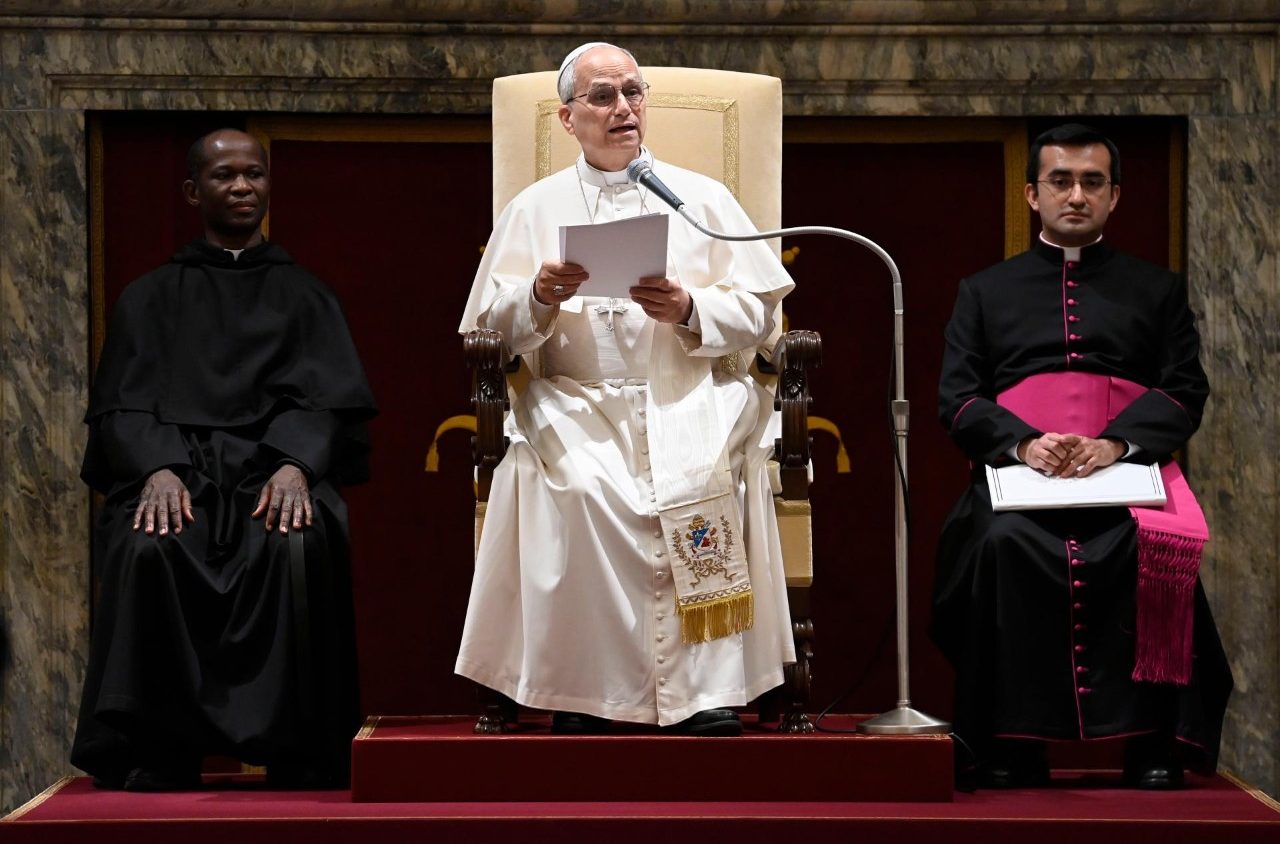

Pope Leo XIV calls on communities to look to the Holy Family of Nazareth to rediscover their calling to welcome others and learn to walk the path of service, as he addressed participants in the “Cathedra of Hospitality.”
By Deborah Castellano Lubov
“I encourage you to be educators in hospitality,” Pope Leo XIV said on Thursday in the Vatican when addressing participants in the “Cathedra of Hospitality,” a cultural and educational event now in its fourth edition, held in Sacrofano, a town north of Rome.
Organized by movements and Third Sector organizations in collaboration with Rome’s Pontifical Lateran University, the event provides spaces for dialogue and reflection on current issues. This year, the theme was “Youth and the Church: Hospitality that fosters belonging.”
In his remarks, the Holy Father offered reflections on the theme addressed by the “Cathedra.” The Pope acknowledged that the days of reflection were animated by the awareness that the Christian vocation is oriented toward generating communion among people.
With this in mind, the Pope observed that communion arises from the ability to welcome others by offering listening, hospitality, and assistance.
The grace of an encounter
Pope Leo XIV said that at the heart of every authentic welcome, there is a relationship born from the grace of an encounter. He explained that it is precisely within this dynamic of encounter that the decision to dedicate the fourth edition of the “Cathedra” to young people is situated.
“In a time marked by profound cultural and social transformations,” the Pope said, “young people, who are naturally the future of society and of the Church, already constitute its living and generative present.”
The Holy Father noted that their questions and concerns invite us to renew the style of our relationships.
“Welcoming young people means, first of all,” Pope Leo said, “listening to their voices, meeting their gaze, and recognizing that, in their lives and in their languages, the Spirit continues to act and to suggest renewed paths of presence and care.”
Presence and care
The Pope said he wished to dwell on two words, namely “presence” and “care,” which help illuminate the Christian meaning of hospitality.
“Each of us, from the first moment of life,” he pointed out, “grows within a social reality,” citing the family, the parish, the school, the university, and the workplace. Each of these, he noted, represent models of society where different psychological, juridical, moral, pedagogical, and cultural dimensions intersect, and “are spaces of identity formation whose primary task is defined precisely by presence.”
“To be present in the lives of others,” Pope Leo XIV emphasized, “means sharing time, experiences, and meaning, offering stable points of reference in which others can recognize themselves and grow.”
“Looking to the Holy Family of Nazareth,” the Pope said, “every welcoming community can rediscover its own calling and learn to orient itself along the path of service.”
The experience of the Holy Family
Pope Leo suggested that the Gospel episode in which Mary and Joseph cannot find Jesus, and, in anguish, find Him again after three days in the Temple, teaches that the presence of the other is not automatic but the result of a constant search.
“It has happened to each of us,” the Pope observed, “to lose someone or something to which we were deeply attached. In that moment we realize how precious that presence was.”
The same happens in the life of faith, he said. “We often take for granted the presence of Jesus in our existence until suddenly it seems that He is no longer where we left Him.”
Called to seek Jesus
“We feel a sense of loss,” the Pope said. “In reality, it is not He who has been lost, but we who have moved away.”
When this happens, Pope Leo explained, we are called to seek Him with trust and with the courage to travel unexplored paths, looking at the world with new eyes filled with hope.
“In this way,” he said, “we will stop looking for a God made to our own measure and instead encounter Him where He dwells.”
Seeking Jesus, Pope Leo XIV added, therefore means passing from the security of our convictions to the responsibility of encounter, learning to see and welcome the presence of God who is always “beyond.”
St. Joseph’s powerful example
“This is precisely what Saint Joseph did in safeguarding the family entrusted to him by the Lord,” Pope Leo said.
In Joseph, the Pope explained, we recognize that welcoming, in addition to presence, is also care.
“To care,” Pope Leo said, “means to stand beside the other with attention, to respect their choices, and to take responsibility for them.”
This attitude, he noted, belongs first of all to God, whom the Bible shows as the guardian of His people. He explained that the human family, too, is called to preserve what has been entrusted to it.
“Thus Joseph,” the Pope observed, “shows us that presence and care are inseparable dimensions: one does not safeguard without being present, and one is not truly present without assuming responsibility for the other.”
Moving toward holiness
With this sentiment, Pope Leo XIV suggested that presence and care can represent two lamps along the path toward a form of hospitality capable of opening paths to holiness.
Thanking those present for their silent and discreet commitment, the Pope encouraged them to be educators in hospitality and to continue together “to create environments capable of promoting goodness and fraternity in the Christian community and in society.”
