
The Laudato si’ Center for Higher Education and the University of Notre Dame bring together academics and representatives from international organizations to pool knowledge and best practices to promote integral ecology and sustainability.
By Isabella H. de Carvalho
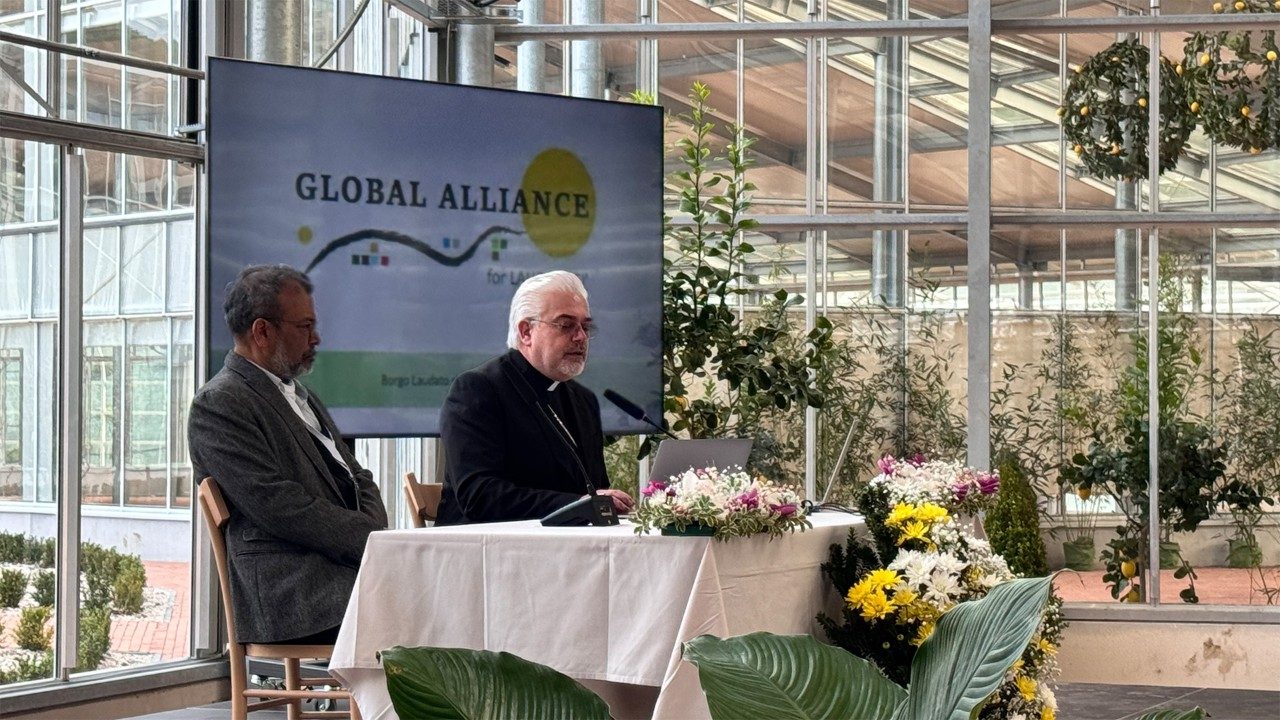
Over 60 representatives from universities and major international organizations from all over the world gathered on Monday, March 9, to launch the Global Alliance, an international initiative focused on bringing actors together to promote integral ecology and sustainability.
The gathering took place against the backdrop of secular trees and amid the gentle presence of farm animals in the scenic setting of the Laudato si’ Village in the Papal Gardens in Castel Gandolfo – about an hour away from the Vatican. The Village aims to promote and implement the principles detailed in Pope Francis’ 2015 encyclical Laudato si’ through education, a circular economy and sustainable initiatives.
The event, which ends on Tuesday, March 10, was organized by the Laudato si’ Center for Higher Education and the University of Notre Dame. It featured discussion panels on various topics – ranging from forming leaders in integral ecology to climate justice -, tours of the gardens, and moments to exchange experiences and reflections on these topics.
Cardinal Fabio Baggio, General Director of the Laudato si’ Center for Higher Education, and one of the founders of the Global Alliance, explained to Vatican News that after beginning their partnership with the University of Notre Dame, they realized the necessity of gathering together all those who have worked on Laudato si’ and integral ecology, to pool the knowledge acquired and develop new ideas for future research and concrete initiatives.
“One of the outputs that we thought since the beginning was to create a Global Alliance where people here will commit to producing more research and disseminating awareness about the ecological conversion,” he explained.
Cardinal Baggio also highlighted the importance of translating discussions into concrete actions within one’s institutions by implementing “models of ecological conversion” that can be visible and tangible.
In this respect, he pointed out that the Laudato Si’ Village is the perfect backdrop for this initiative as it is “supposed to be one of these models, where the principles of Laudato si’ are put in practice, where people can come and touch and experience exactly what ecological conversion is about.”
A starting point for changing the world
At this event “there are competent people coming from different corners of the world, different universities, different perspectives but with one objective, which is we want to share good ideas and good practices in order to live according to Laudato si’s principles,” underlined Sister Alessandra Smerilli, Secretary of the Dicastery for Promoting Integral Human Development and member of the Board of Directors of the Laudato si’ Center for Higher Education.
“I hope that this is the starting point of something that can create a critical mass to change the world,” she added.
Arun Agrawal, founding director of the Just Transformations to Sustainability Initiative at the University of Notre Dame, in this regard also emphasized that the Global Alliance “is very different” from an academic conference, as it wants to “begin a series of actions and a series of groups that will work together, that will build community” to call on all of humanity to an ecological conversion.
He underlined that the University of Notre Dame, as a leading research university, ”felt that it could assist the Holy See in its objective to share the principles of integral ecology.”
Academics at the service of the Church
Following this same line of thought, Father Daniel Groody, Vice President and Associate Provost for Undergraduate Education at the University of Notre Dame, emphasized that the institution “can be at the service of the Church” by connecting it with researchers and academics.
“The issues we face” when it comes to the environment and climate change “are complex and challenging,” so coming together, “we can do more collectively” to make the world a better and more sustainable place, he explained.
Additionally, Father Groody highlighted how the Laudato si’ Village is “becoming really a major centre for thinking about these issues of sustainability and the care for our common home.”
“Pope Francis really planted the seed for this, but our world is in need of it,” he continued. “So coming together here as the Catholic Church and as a common human family, we can speak of this, we can address this universal human need.”
Lively panel discussions
“I think we’re all very grateful for the opportunity that Pope Francis gave us when he introduced this concept” of integral ecology, said Professor Maria Assunta Cuyegkeng, from the Ateneo de Manila University in the Philippines, adding that his encyclical helps give academics in this field a direction.
She participated in the panel reflections focused on forming leaders in integral ecology and said the “discussion was very lively.”
Jesuit Father Peter Rožič, Director of the Integral Ecology Research Network at the University of Oxford’s Laudato si’ Research Institute, also expressed his appreciation for the event. He was invited to speak on how Catholic universities can build practical infrastructure, and “how do we ourselves as an institution and as a community of institutions become prophets as well as practitioners of integral ecology.”
About the Author