
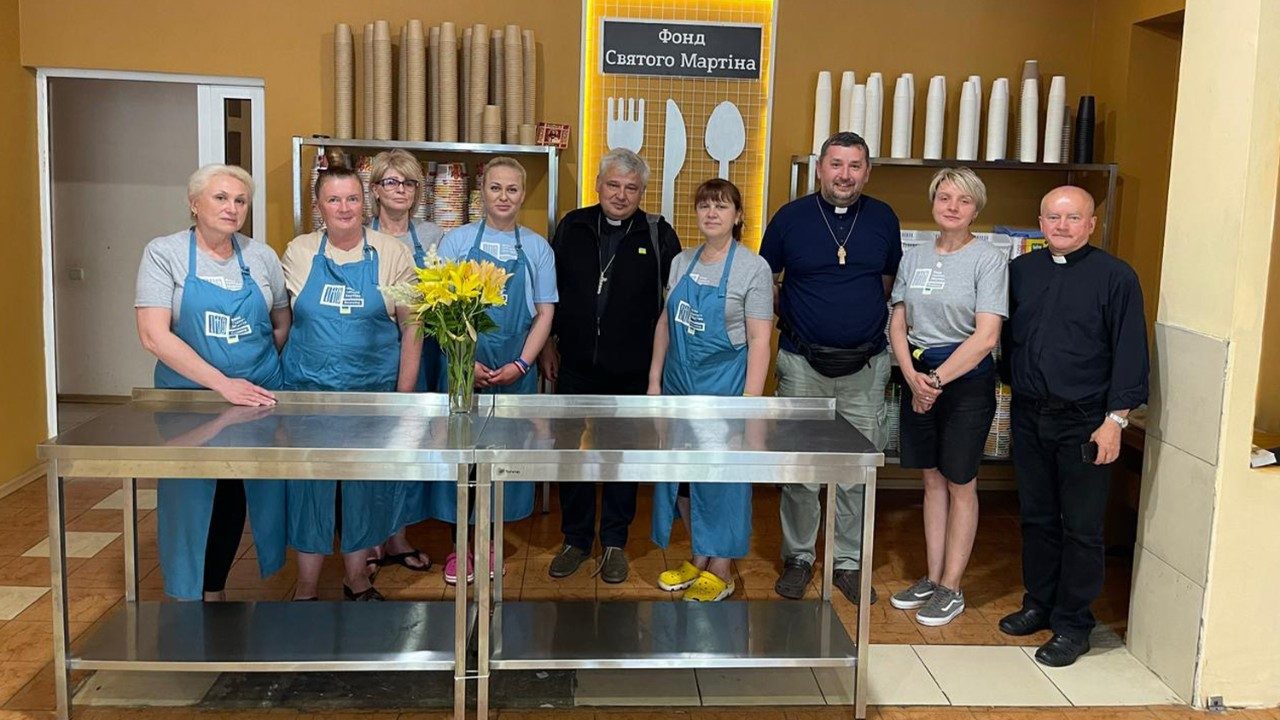
Dominican Father Mykhailo Romaniv regularly travels over 500 kilometers to the front lines to provide aid in one of the most war-torn cities, Kherson, through a social kitchen. A recent visit from Cardinal Timothy Radcliffe helps offer support and help to the community there in the midst of bombardments.
By Alina Petrauskaite SCM and Svitlana Dukhovych
In an interview with Vatican News, Dominican Father Mykhailo Romaniv shared how in the city of Kherson, Ukraine, “the basis of survival is the ability to rely on others. Without mutual support, it is very difficult to survive here.”
As the director of the San Martino de Porres Center in Fastiv, Fr. Romaniv oversees a social kitchen and various humanitarian projects in Kherson, supported by Pope Leo XIV through the Papal Almoner, Cardinal Konrad Krajewski.
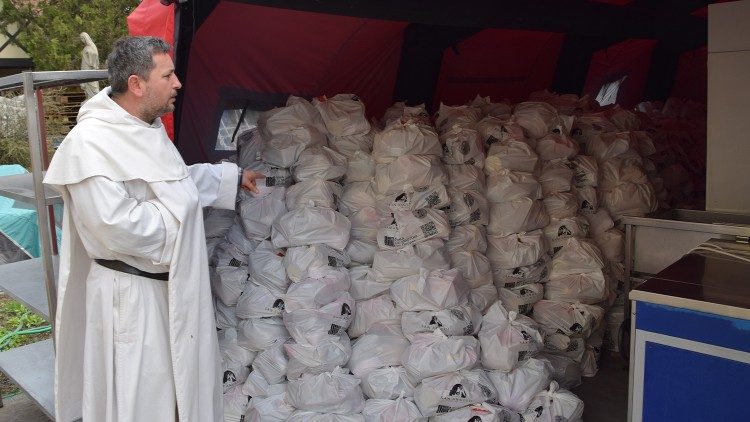
Father Mykhailo Romaniv with aid packages for the people of Kherson (don Mariusz Krawiec SSP)
Cardinal Radcliffe’s visit to Ukraine
Recently, Cardinal Timothy Radcliffe visited Ukraine and witnessed these humanitarian initiatives up close. “His presence,” Father Romaniv explained, “was a sign of hope. He met with the people and, with tears in his eyes, said that he too is learning a lot from them.”
For a city like Kherson, acts of solidarity are truly vital as it is one of the most bombarded cities and regions in Ukraine. Both the residents and those helping them live under the constant threat of bombing, with the real risk of losing their lives.
At the beginning of the large-scale invasion, the city and part of the region were occupied by Russian forces. In November 2022, the Ukrainian army liberated the right bank of the Dnipro River, including the regional capital, while the left bank remains under occupation.
Missiles, bombs, and a deserted city
The front line now runs along the Dnipro River, which is about four to six kilometers (about 2.5 to 3.7 miles) wide at this stretch. From there, Russian forces hit Kherson and nearby villages daily with artillery, drones, missile systems, and airstrikes. According to city officials, over 2,500 attacks were recorded in Kherson in January 2026 alone.
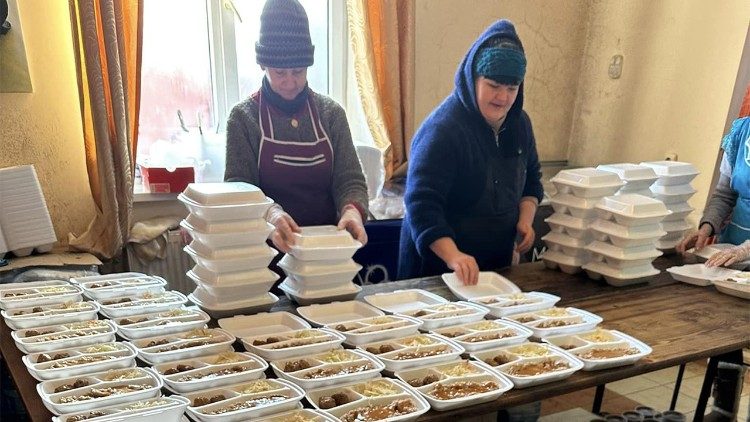
Volunteers in the social kitchen in 2024
In the following month, the intensity of the bombings increased threefold. The danger is exacerbated by the proximity of the front line—an artillery shell can hit the city in mere seconds, often making any effective warning impossible. Before the large-scale war, Kherson had a population of about 323,000, but now only 10-20% remain, with evacuations and population shifts ongoing.
A priest’s commitment
Father Romaniv belongs to the Dominican community in Fastiv, near Kyiv, while Kherson is located more than 500 kilometers (more than 300 miles) away. Recalling how the idea of opening a social kitchen in Kherson came about, he reflected on the early months of the invasion, when their community helped evacuate people from the most dangerous areas, including Kherson.
“We weren’t just trying to get people out; we wanted to accompany them—finding places where they could settle and receive the necessary support,” he said. During the city’s occupation, the Dominican community in Fastiv tried in various ways to deliver medicine, hygiene products, and other essentials to Kherson.
“Sometimes,” the Dominican priest recalled, “aid was even delivered by boat, and we never stopped sending it.” Moreover, the religious community often repeated, “As soon as Kherson is liberated, we will go there.”
That is just what they did. On November 18, 2022, the Dominicans arrived in the city, just a week after its liberation. “Since then, we have been present here, alongside the people”, Father Romaniv noted. The Dominican community in Fastiv started regularly bringing humanitarian aid to various centers in the Kherson region. Over time, the idea to create something permanent—a place where people could regularly receive support—took shape.
“Tell Me What You Need”
Father Romaniv recalled a visit by Pope Francis’ Almoner, Cardinal Konrad Krajewski, to the San Martino de Porres Center in Fastiv during Christmas 2022. “On that occasion, he said to me: ‘If you need anything, call me and tell me what you need.’”
Later, Father Romaniv wrote to the Cardinal explaining the project of opening a social kitchen in Kherson. “Honestly,” the Dominican priest confided, “we had no funds to start the project. Preparing the location and purchasing the equipment was costly and impossible to sustain without external help.”
A response came that very evening. “The Cardinal wrote to say that Pope Francis wanted to personally support our kitchen and was sending the funds to open it. He added that in the Gospel we see how people respond immediately to Christ’s call, without delay. Those words deeply moved me,” Father Romaniv said. “We understood that this project had a truly special blessing.”
The social kitchen has been running for almost three years now. Later, a bakery was also opened, producing bread and sweets for the city and nearby villages. In 2024, a social laundry service was also established in Kherson for local residents.
Maintaining spaces of hope
Father Romaniv explained that since he began regularly visiting Kherson in 2022, the danger has only increased. A particularly serious threat is the constant drone attacks on the city.
“A month ago, on February 6, a ‘Grad’ rocket struck our social kitchen and pierced the thick concrete roof. A few months earlier, there had been an artillery attack, shattering all the windows. This is the constant reality the people live in,” the Dominican explained.

The kitchen was hit by a rocket on February 6, 2026
Despite everything, for Father Romaniv, the key is to keep a space of hope alive. “We also operate a heating center. Recently, during a visit, I met some elderly women there who were drinking tea, eating our sweets, waiting for lunch, and watching TV. There’s a sense of home, a feeling of being remembered and having someone close. In these conditions, that means a lot,” he highlighted.
In nearly three years of operation, the social kitchen has served approximately 450,000 meals.
The laundry service, managed by the Dominicans, is also vital, especially for residents of the Ostriv district, who have lived for about eight months without electricity, water, or gas in freezing apartments.
“The least we can do is offer them the chance to wash their clothes. Next to the laundry, there’s a welcome room where people can warm and wash up. They are simple things, but in them, the essence of ordinary humanity is revealed,” Father Romaniv explains.
Ongoing support from the Pope
Father Romaniv emphasized that the Pope’s support, channeled through Cardinal Krajewski, has not only been instrumental in the initial stages of the social kitchen but continues to this day.
“Cardinal Konrad Krajewski remembers us and helps us regularly. We can say that about 50% of the funding for our projects comes from his support. We are deeply grateful to him and the Holy Father,” the priest said.

Cardinal Krajewski helping with distribution of aid in Ukraine
In addition to this support, the community also receives aid from other sources: Polish organizations and some partners in the United States. “We try to distribute resources evenly across all our initiatives. Besides the kitchen in Kherson, we manage a kitchen in Fastiv, have opened a heating center in Borodianka in the Kyiv region, and send aid to other cities like Kharkiv, Dnipro, Odessa, Chernihiv, and more. Needs are everywhere, so we try to support various regions.”
In the Kherson region, the Dominican Fathers also help deliver bread and potable water to some villages where residents cannot leave due to the constant threat of drones. In the city, they participate in a social transport project offering free rides to and from the hospital or organizing evacuations from the most dangerous areas.
Together with volunteers and social services, they also ensure that meals are delivered to those bedridden or with reduced mobility. “Often,” Father Romaniv revealed, “the residents themselves help. Those who come to collect meals also take a portion for their neighbors. This is an important form of solidarity and self-organization within the community. I believe that in Kherson, this ability to rely on each other is the true foundation for survival. Without mutual support, it is very difficult to live here.”
Incredible strength
When asked what helps him maintain hope in these difficult circumstances, with drones constantly buzzing overhead, Father Romaniv responded: “For me, a special sign of hope was Cardinal Timothy Radcliffe. Recently, he was here with us, and he visited the social kitchen, the laundry, and the places where volunteers prepare humanitarian packages.”

Moments from Cardinal Radcliffe’s visit to Kherson
Moreover, the Dominican priest recalled how the cardinal was moved by the people he met and said he was learning a lot from them. “What deeply moved me was that he himself asked the people to bless him. He said he saw Christ in them because what they do is for God. Not all of our workers are deeply religious, but when they embraced the Cardinal, who will turn 81 in a few months, everyone cried. For me, these are very strong signs of God’s presence. Listening to his words about hope, peace, and the victory of Ukraine gives incredible strength to keep going.”
