
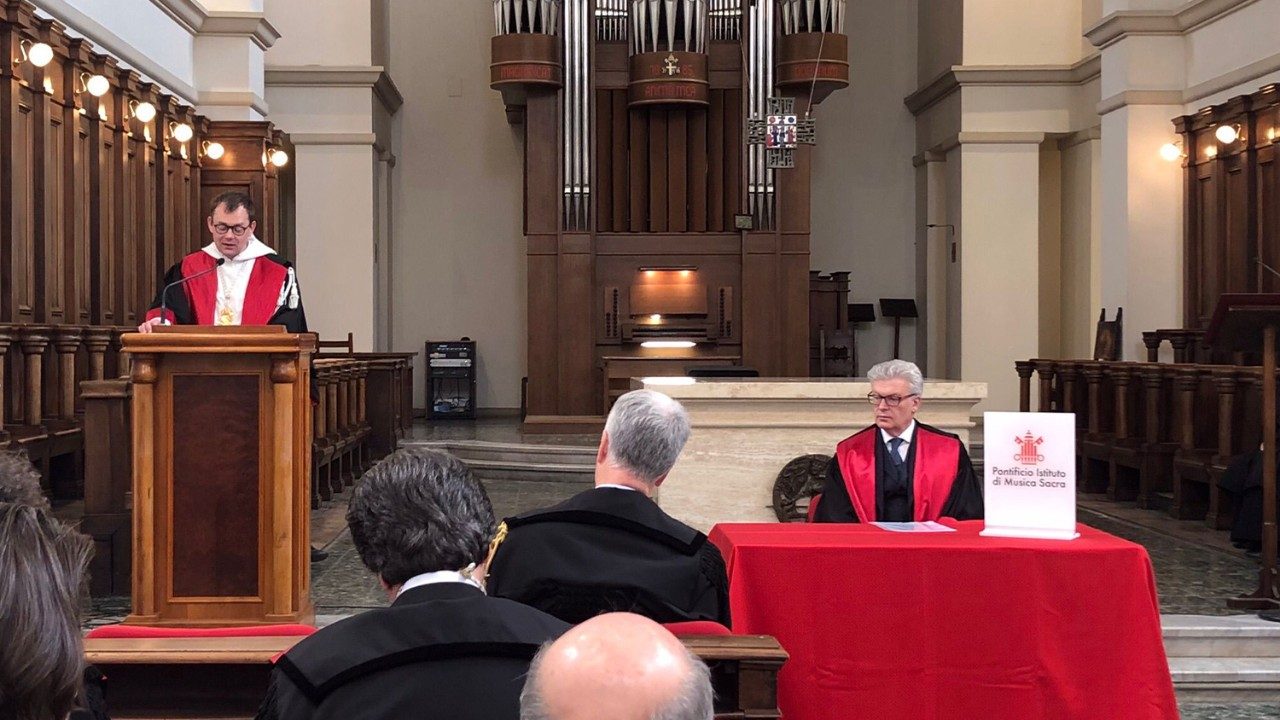

Sir James MacMillan receives a Doctorate Honoris Causa at the Pontifical Institute of Sacred Music and delivers a lecture on the spiritual and creative role of silence in sacred composition. In an interview with Vatican Radio, he reflects on tradition, liturgy, and the legacy of Pope Benedict XVI for contemporary composers.
By Marco di Battista and Linda Bordoni
“The Sound of Silence: Sir James MacMillan’s Vision for the Modern Sacred Music” is the title of a Lectio Magistralis delivered by the Scottish composer and conductor, Sir James MacMillan, who was awarded a Doctorate Honoris Causa in Sacred Music at the Pontifical Institute of Sacred Music on Friday, March 6.
Sir MacMillan is a leading voice in classical music, renowned for his deeply expressive compositions that intertwine his Scottish heritage, Catholic faith, and commitment to social justice.
In his lecture, he reflected on silence, faith, and the role of the composer in the modern age, highlighting silence as a presence, the spiritual purpose of music, and the relationship between tradition and innovation in sacred composition.
In an interview with Marco Di Battista following the event, Sir James MacMillan expanded on those themes and upheld the legacy of Pope Benedict XVI and the role of Sacred Music in the liturgy.
Silence as a source of creativity
“Many composers recognise that silence is absolutely fundamental to their imagination, that it’s when they descend into that silence that the music begins,” he said, noting that, although music is sound, its genesis lies “in the silence of one’s own hearts.”
He connected this reflection to faith, observing that “Christians know that deep in the silence of our hearts is the place where we encounter God.”
Tradition and innovation in sacred music
MacMillan stressed that writing sacred music does not mean copying past styles. He said that living composers should “be aware of what the importance of that tradition is, and perhaps could be shaped by it in some way.”
He cited Gregorian chant and Renaissance polyphony as foundations for Catholic musical sound, and referring to Pope Benedict XVI, he recalled the importance of linking the deep past with contemporary composition, encouraging composers to draw inspiration from the musical heritage of the Church.
Sacred music and the liturgy
The composer reflected on the purpose of sacred music in worship. “We don’t go to Mass to be entertained. (…)Sacred music in and outside the liturgy is to channel our thoughts and our prayers towards God,” he said. Music, he added, must serve the prayer of the assembly, rather than act as entertainment.
Musical language and responsibility
Asked whether his musical language changes between sacred and secular works, MacMillan said his approach is “quite fluid and quite pluralist. (…) Having said that, there is something very important about writing specifically for the liturgy because the composer is writing music which has to carry and help the thoughts, the deep thoughts and contemplations and prayers of the assembly, and to carry them towards the altar of God.”
