
In the vast, sun-scorched plains of northwestern Kenya, where distances are long and life is fragile, the Church continues her mission of presence and hope.
Rose Achiego Ande – Lodwar
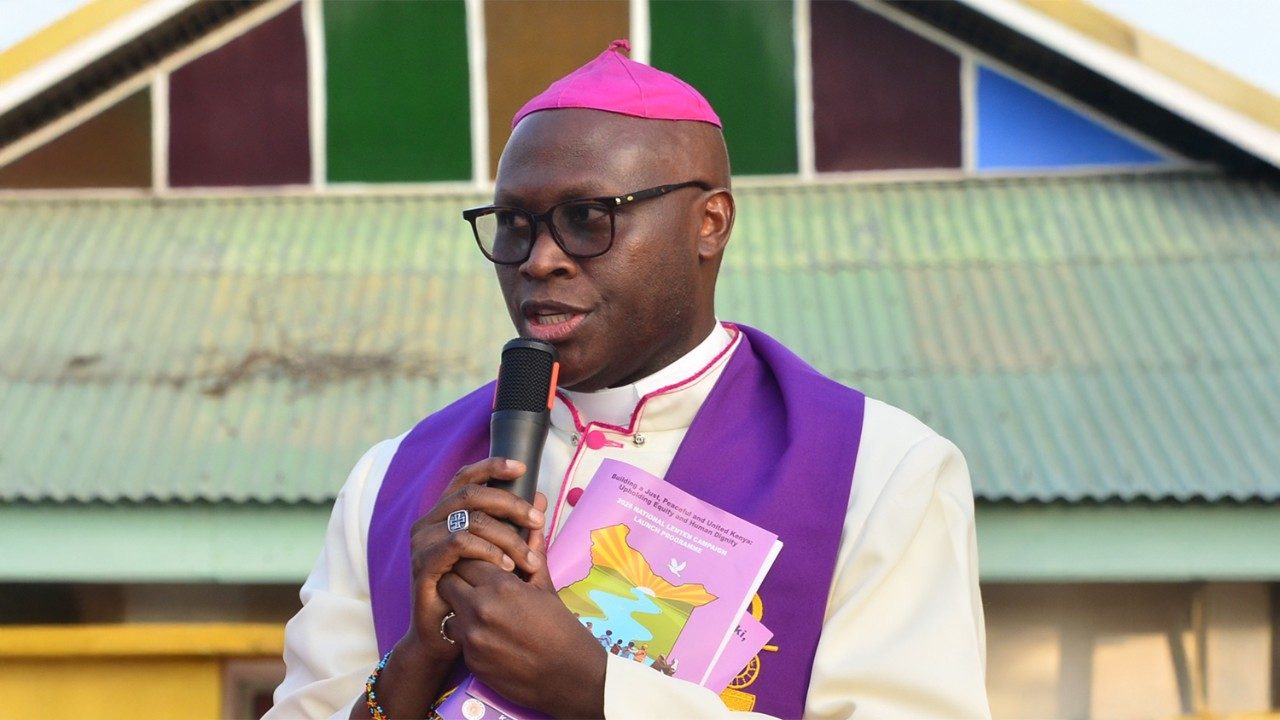
“My name is Bishop John Mbinda of the Catholic Diocese of Lodwar,” says the shepherd of the local Church that stretches across nearly 77,000 square kilometres of arid and semi-arid land in Lodwar. The diocese, located in Turkana County, borders South Sudan, Ethiopia and Uganda, placing it at a geographical and pastoral crossroads.
Predominantly inhabited by the Turkana people, the region is also home to civil servants, missionaries and religious men and women from other parts of Kenya. Together, they form a small but determined Catholic presence in what Bishop Mbinda, a member of the Spiritan congregation, describes as “an area of first evangelisation.”
A mission of presence
The Diocese of Lodwar counts 33 parishes, many located in extremely remote areas. Yet these are not self-sustaining communities. Sunday collections in several parishes do not cover even the cost of fuel required for pastoral outreach.
“We created these parishes to ensure that the Word of God comes closer to the people,” the Bishop explains. “The priest must be near; the catechist must be near.”
In a land where communities move in search of water and pasture, the diocese has also trained nomadic catechists who accompany families on the move, bringing the Gospel into the rhythms of pastoral life.
The work, however, comes at great cost. Catechists require formation and modest remuneration. Meetings demand transport support across long and often impassable routes. Outside the recently tarmacked trunk road from Kitale towards the South Sudan border, most roads remain rough and difficult.
Funding for pastoral ministry, Bishop Mbinda notes, is increasingly scarce. “Few want to support vehicles for evangelisation or training for lay leaders,” he says, appealing to better-resourced Churches to support mission territories where faith is young and fragile.

Women from the indigenous Turkana Nilotic community at a WFP food distribution centre
Hunger and Eucharistic joy
Material deprivation is part of daily reality. Temperatures regularly rise above 37 degrees Celsius. Access to water, health care and basic services remains limited in many areas.
The Bishop recounts moments that reveal both hardship and grace. During a Confirmation celebration in a remote parish, several women and children collapsed. They were not ill; they had simply not eaten for two or three days, he explained.
“And yet,” he says, “the joy with which they receive the Good News, the smiles even in adversity, are what keep us going.”
Despite hunger and poverty, the Eucharist is celebrated with deep fervour. In these desert communities, faith is not an accessory but sustenance.
Health, water and human dignity
Inspired by the Gospel mandate in Matthew 25, the Diocese of Lodwar combines evangelisation with concrete acts of charity. Through its Caritas structures and pastoral wing, the diocese runs more than 18 health facilities in remote areas, often where the government presence is minimal.
However, recent changes in Kenya’s health insurance system, including the transition from NHIF to the new Social Health Insurance framework, have left many Church-run facilities struggling. Delayed reimbursements have made it difficult to pay staff and maintain essential medical supplies, placing some facilities at risk of closure.
Beyond health care, water is central to survival. The diocese operates one of the most robust water programmes in the county, drilling and maintaining wells in desert communities. “Water is one of the greatest gifts you can give to a people living in these conditions,” Bishop Mbinda says.
Environmental care is also part of the mission. Communities are encouraged to plant and nurture trees near water points, promoting resilience in an unforgiving climate.

Planting trees near water sources
Serving refugees in Kakuma
Within the diocese lies one of Africa’s largest refugee settlements, the Kakuma Refugee Camp, which hosts more than 250,000 refugees. The Church works closely with partners, including the UNHCR, to support displaced populations.
Religious congregations, among them the Salesians of Don Bosco, provide technical training and education. Women religious offer skills formation, such as tailoring, to foster self-reliance.
Recent global funding cuts have affected food rations and services in the camp, increasing tensions. Yet the Church remains present, walking with refugees and advocating for their dignity.
A land of immense potential
Despite formidable challenges, Bishop Mbinda sees enormous promise. “The greatest potential,” he says, “is the longing of the people to receive the Good News.”
In Turkana’s dry expanse, the soil may be harsh, but hearts remain open. The Diocese of Lodwar continues to plant seeds of faith, often with limited resources but sustained by the joy of the people and the quiet conviction that mission, at its core, is presence.
In the desert, the Gospel still finds fertile ground.
