
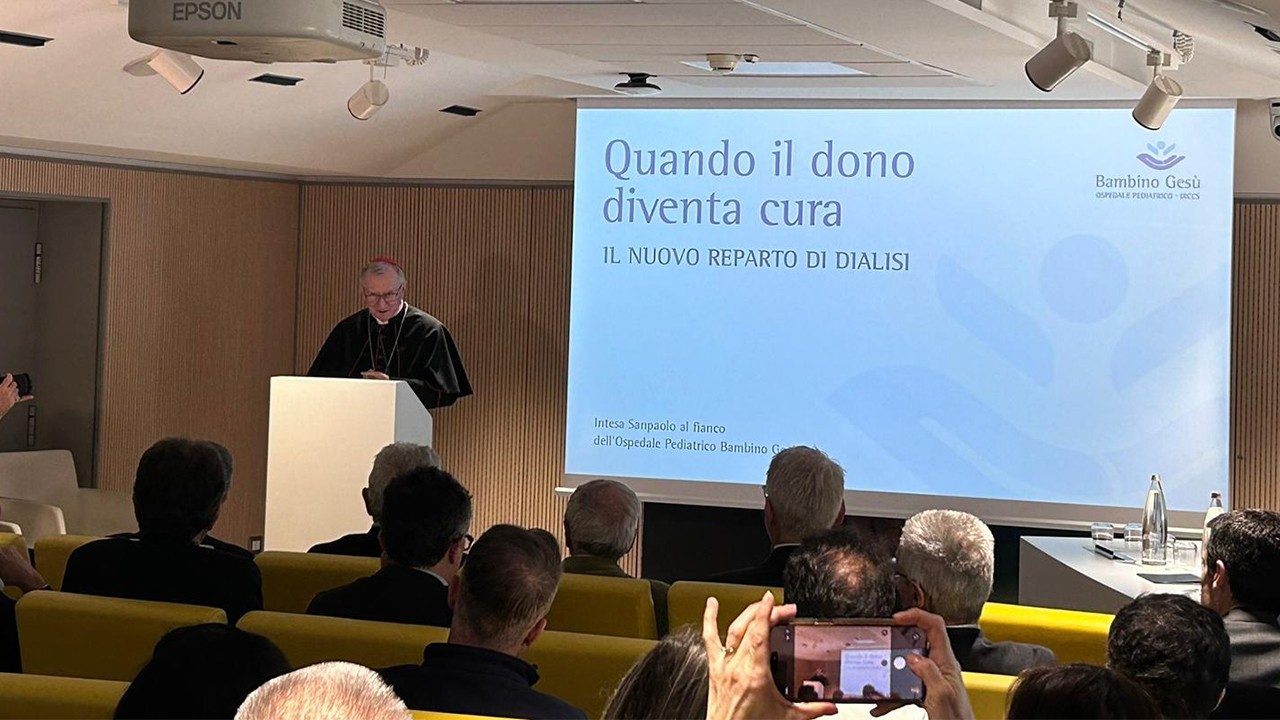
Cardinal Pietro Parolin visits the new dialysis unit at the Bambino Gesù Pediatric Hospital and speaks at a conference titled “The Culture of Giving”, affirming that every contribution becomes “providence passing through human hands.”
By Edoardo Giribaldi
Cardinal Secretary of State Pietro Parolin visited the new dialysis unit at the Bambino Gesù Pediatric Hospital in Rome and spoke at a conference titled “The Culture of Giving”.
Reflecting on the nature of giving in an age when everything is measured “in terms of profit, performance, and utility,” Cardinal Parolin asked: What can we give?
A great deal—in fact, we can give everything. Money, which when inspired by charity becomes a “tool of justice”; an organ, to reaffirm a love that “transcends death”; and time, which in today’s frenetic world becomes “one of the highest forms of charity.”
These were the themes of the Secretary of State’s address on the morning of February 17 in the Salviati Hall of the Bambino Gesù Hospital at its Piazza Sant’Onofrio site on Rome’s Janiculum Hill. Before the event, the Cardinal visited and blessed the hospital’s newly renovated dialysis department.
The conference panel also consisted of Tiziano Onesti, president of Bambino Gesù; Dr. Francesco Emma and Dr. Isabella Guzzo, heads of pediatric nephrology and dialysis and the kidney transplant program; Paolo Bonassi, Chief Social Impact Officer of Intesa Sanpaolo, which funded the renovation; and patient Samuele Galimberti, who shared his testimony. The discussion was moderated by Tg1 Vatican journalist Ignazio Ingrao.
Financial giving as a concrete form of love
“Giving is a silent yet immensely powerful language through which men and women express the best of themselves,” Cardinal Parolin said, noting that generosity allows us to step outside ourselves and open up to others. While giving takes many forms, all glorify God when carried out with “pure hearts and intentions.”
Financial giving, often regarded as “the simplest and least spiritual” form, can nonetheless become a concrete expression of love. Jesus himself highlighted this in recalling the widow who offered a few small coins at the Temple—insignificant in appearance, yet precious in meaning.
“We must trust in God, but He works through human beings,” the Cardinal summarized. Economic generosity, he stressed, “restores dignity” and makes future care possible. He thanked all who support the Bambino Gesù Hospital, noting that they are not only making a generous gesture but participating in a “mission of care and hope, safeguarding life and dignity.”
Organ donation: Going beyond suffering
The Vatican Secretary of State then turned to organ donation, a particularly meaningful act in dialysis wards. It reflects the words of Jesus: “No one has greater love than this, to lay down one’s life for one’s friends.”

The meeting “When Giving Becomes Care” at Bambino Gesù
This gesture takes on even deeper significance when, in the “immense suffering” of loss, a parent is able to generate “life, hope, and a future” for others—overcoming despair and offering another child “the chance to grow up.”
“Human life is relationship and communion; in a donated body there beats a love that does not surrender to death,” Cardinal Parolin said.
The gift of time in a frenzied world
Closing, the Cardinal spoke of a gift accessible to all: time. “Knowing how to listen, to accompany, to remain at someone’s side. Telling someone: you matter to me.”
He pointed to the many volunteers who assist patients and families quietly, embodying the parable of the Good Samaritan—stopping, drawing near, and caring. Cardinal Parolin also thanked doctors, nurses, and healthcare workers, whose professions are true vocations requiring the union of “technical skill and humanity.”

The panel of speakers at the Bambino Gesù hospital
Every act of care, he said, is a “concrete response to Jesus’ command: ‘I was sick and you visited me,’” fostering a fraternity that becomes tangible support and friendship rather than mere theory. Cardinal Parolin reiterated that “the quality of a civilization is measured by its ability to care for the weakest,” recalling that at the root of every gift lies a profound truth: recognizing that we ourselves have received everything as a gift.
Samuele’s Testimony
Seventeen year old Samuele Galimberti, who before receiving a kidney transplant underwent both peritoneal dialysis and hemodialysis, also shared his testimony. The demanding treatment forced him to spend much of his adolescence—the age of carefree socialization—primarily in hospital, including his first day of high school.
The psychological toll led him to lose hope, until the long-awaited “call for a kidney” arrived. From that moment, a “new life” began. Samuele grew 30 centimeters, gained weight, and found success in sports. Last August in Germany, he became world champion in the 5,000 meters at the World Transplant Games.
Yet, he has not forgotten those who helped him. “Every evening I pray twice—once to God and once for my donor, who is my guardian angel. He saved my life”, he shared.
Closing the event, the president of the hospital recalled that “investing in children” represents “the true well-being of a community” and expressed hope for a “qualitative leap” in overcoming the prevailing “culture of profit.”
