
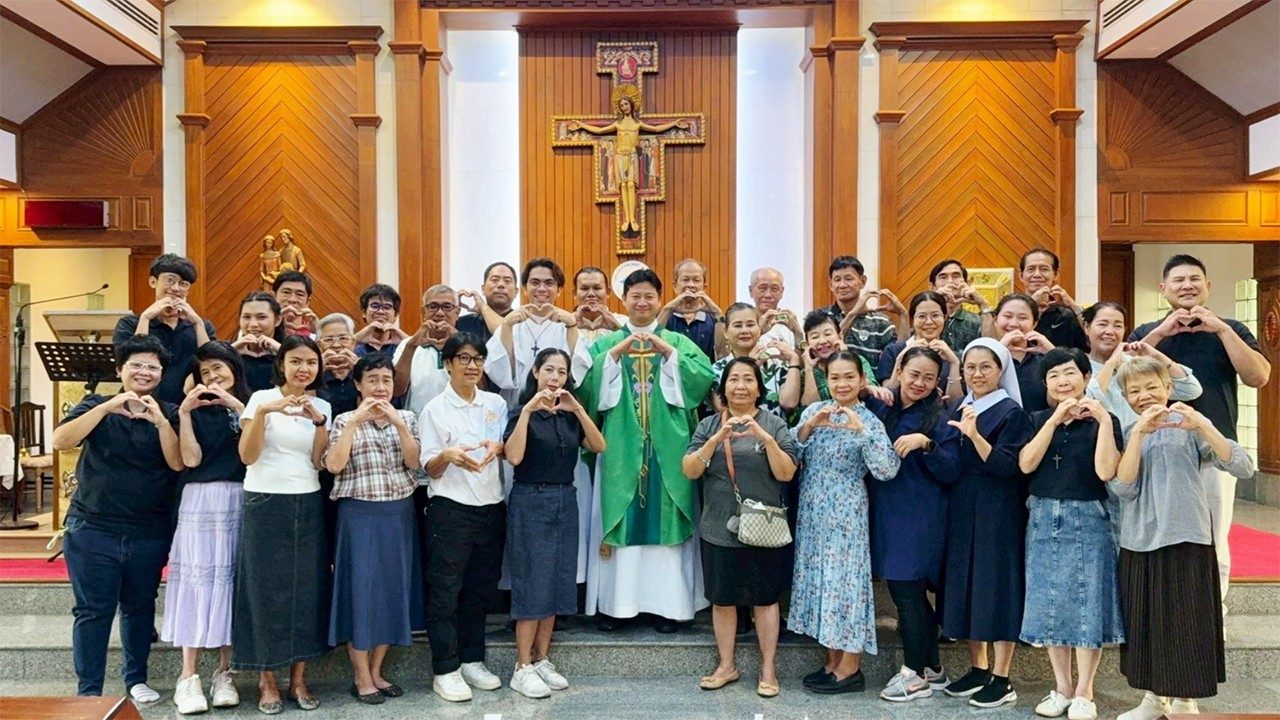
The Catholic Bishops’ Conference of Thailand holds its annual retreat for the Deaf and Hard of Hearing, expressing the Church’s desire to make the Gospel accessible to all people.
By Chainarong Monthienvichienchai, LiCAS News
Proclaiming the Gospel and providing pastoral care through sign language is not a “supplementary mission,” but the very pulse of the Church’s identity in the modern era.
This conviction served as the foundation for the annual retreat for the Deaf and Hard of Hearing, held from February 14–15 in Samphran, west of Bangkok.
Organized by the Pastoral Department for the Deaf of the Catholic Bishops’ Conference of Thailand (CBCT), in collaboration with the Diocese of Chanthaburi and the Catholic Association of the Deaf, the gathering sought to bridge the gap between the silent world and the sacramental life of the Church.
For Father Peter Bhuravaj Searaariyah, director of pastoral ministry for the deaf in the Diocese of Chanthaburi, the mission is encapsulated in a singular, poignant vision: “That we all can hear … even those who have no voice.”
“The common understanding is that deaf people are individuals whose voices are often unheard by society,” Father Bhuravaj told LiCAS News.
“In truth, every moment is an opportunity for us to listen to them with the heart of Christ. Proclaiming the Good News in sign language is the heart of the Church’s mission today.”
The Magisterium of Inclusion
The retreat, timed to prepare participants for the penitential season of Lent, emphasized that spiritual growth and the sacraments are universal rights.
Father Bhuravaj, who also coordinates national pastoral care for the CBCT, stressed that excluding the deaf from evangelization is equivalent to excluding them from grace itself.
“Deaf people are children of God, created in His image,” he noted. “Jesus redeems all people without exception. If they are not taught proper doctrine in a language they understand, they are unjustly neglected. The Church must be a home for everyone, not just those with hearing.”
The weekend functioned much like a traditional silent retreat, though with a unique linguistic twist.
In this space, “silence” did not mean an absence of communication, but a shift to Thai Sign Language (TSL). All activities, including the Holy Sacrifice of the Mass, were conducted in TSL, supported by trained interpreters, and celebrated by Father Bhuravaj himself.

Participants at the annual retreat for the Deaf and Hard of Hearing engage in prayer and reflection using Thai Sign Language during a formation session in Samphran, west of Bangkok. Photo: Fr. Peter Bhuravaj Searaariyah
Missionaries in a ‘Silent Land’
The program featured diverse perspectives on the missionary calling. Carmelite Brother Joseph Marie Kittibut Mekvichit addressed the necessity of “apologetics,” or defending the faith.
He urged the deaf community to delve into the Catechism of the Catholic Church (CCC), sharing his own vocational journey and his experiences serving in the Philippines.
Similarly, Father John Baptist Hatthachai Wongmaesan of the Thai Missionary Society challenged retreatants to become “missionaries with their lives.”
Drawing on his experiences in Cambodia and with the hill tribes of Chiang Rai, he encouraged the deaf to carry the Light of Christ into their specific social spheres.
Father Bhuravaj described the deaf community and their support teams as “missionaries in the land of the deaf.”
He explained that receiving the Word is not merely about “downloading information,” but about acknowledging Truth so that it bears fruit in the physical, mental, and emotional aspects of their lives.
Obstacles to grace
Despite the spiritual success of the retreat, significant structural hurdles remain.
Government statistics estimate the deaf population in Thailand to be between 200,000 and 375,000. While the exact number of Catholic deaf individuals is unknown, many struggle to access the sacraments due to a critical shortage of priests and religious who can sign.
“The first challenge is language,” Father Bhuravaj explained. “Written or spoken Thai is often not a deaf person’s first language because they have never heard it. This puts them at a disadvantage from the very beginning.”
To counter this, the CBCT is working to make these specialized retreats more accessible, viewing them as essential tools for “holistic personal development” and the fostering of Christian values.
As the retreat concluded, participants returned to their dioceses with a renewed commitment to the motto of their ministry: “Speaking with hands, hearing with eyes, and understanding with the heart.”
By empowering the deaf to lead and evangelize within their own community, the Thai Church moves closer to a future where no child of God is left in a “silent” exile from the altar.
This article was originally published on https://www.licas.news/. All rights reserved. Unauthorized republication by third parties is not permitted.
