
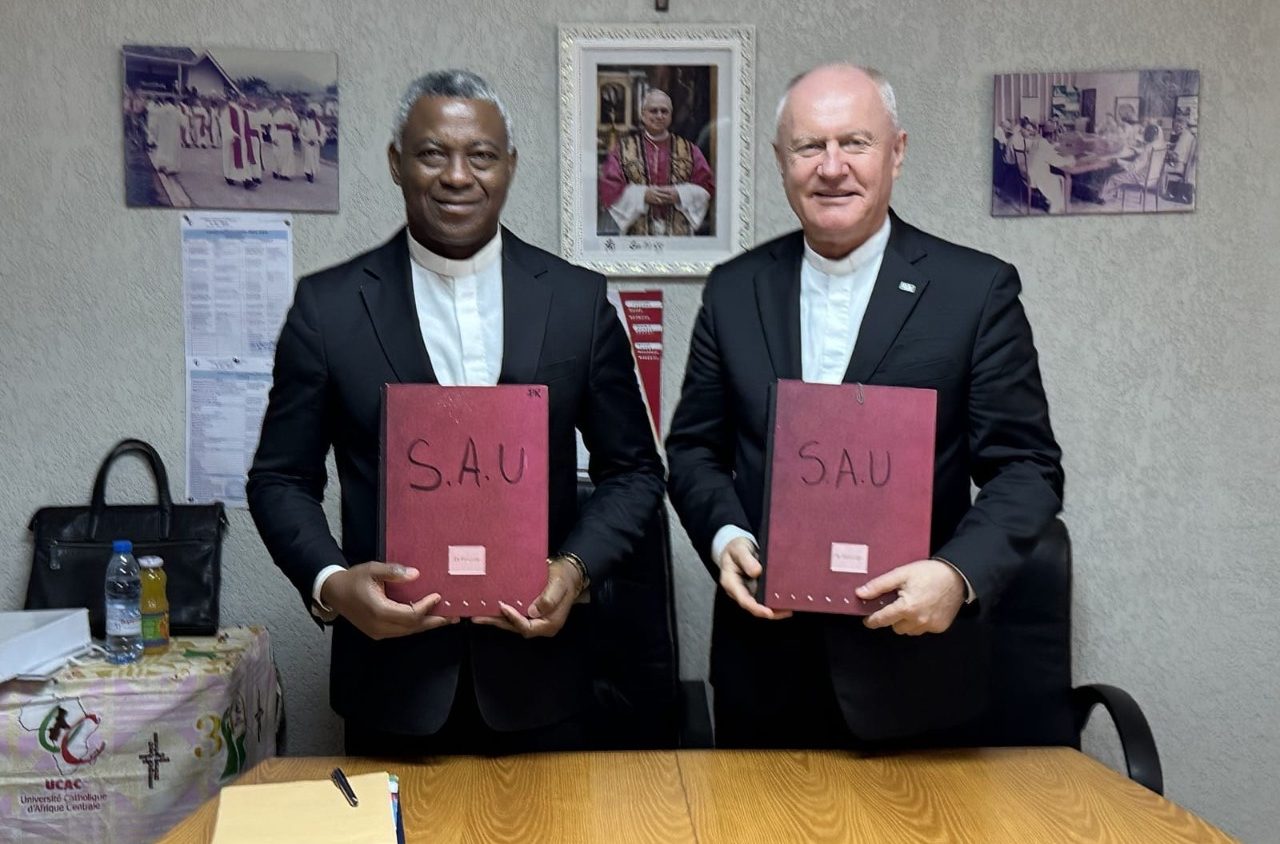
Catholic education as a tool for social change and community building is what the Catholic University of Central Africa in Cameroon (UCAC) hopes to draw upon by signing a cooperation agreement with one of Europe’s largest Catholic universities—the John Paul II Catholic University of Lublin (KUL).
By Monika Stojowska & Wojciech Rogacin
The exchange of experience in the scientific, cultural, and social fields between two important Catholic academic centers is the result of an agreement signed in February between the Catholic University of Central Africa in Cameroon and the John Paul II Catholic University of Lublin in Poland.
The agreement was signed by the rectors: Fr. Prof. Thomas Bienvenu Tchoungui of UCAC and Fr. Prof. Mirosław Kalinowski of KUL.
Due to the academic reach of the Catholic University of Central Africa, the agreement extends beyond Cameroon to include Chad, Gabon, Guinea, Congo, and the Central African Republic.
The Polish Catholic university educates students from Poland and 45 other countries, mainly from Europe—Ukraine, Belarus, and Spain—as well as a large group of students from Central Asian countries and the United States.
Therefore, as Prof. Mirosław Kalinowski emphasizes, cooperation with the university in Yaoundé goes far beyond the borders of Central and Eastern Europe and Central Africa.
“The priority is not only knowledge, but also spiritual formation, which responds to the challenges of the contemporary world,” says the rector of KUL.

From left: Fr. Jean Paul Rene Ondua Omgba, Fr. Prof. Mirosław Kalinowski, Fr. Prof. Thomas Bienvenu Tchoungui
An African existential approach to social challenges
The agreement is the result of a meeting and discussions between the two rectors in the Vatican several months ago.
Both universities see in this pan-continental exchange an opportunity to deepen their own experience and seek common solutions to contemporary challenges. This may be achieved through student and academic staff exchanges.
UCAC is a university with over thirty years of tradition, established by the Conferences of Bishops of Central Africa. For years, it has educated leaders and specialists who serve the Church and society in their respective countries.
Its programs include theology, philosophy, social sciences, law, and health sciences, aligning with local development needs. At the center of its mission is always the human person and human dignity.
UCAC has already been cooperating with universities in Western Europe for many years. This agreement expands that scope to another region of the continent.
The John Paul II Catholic University of Lublin has a rich tradition of more than 100 years, and Karol Wojtyła was among its professors before becoming Pope John Paul II.
The university educates nearly 10,000 students and dynamically develops its research and teaching programs internationally. The partnership with the African university now represents an opportunity for its further growth.
“Above all,” adds Prof. Kalinowski, “it offers integration of European academic experience, especially in the humanities and social sciences, with the African existential approach to understanding reality and responding to concrete social challenges.”
Tools for building community and social change
“KUL’s experience in intercultural dialogue, humanistic ecology, public ethics, and the theory and practice of education can find creative application in the African context of UCAC, where education is also a tool for social change and community building,” the rector of KUL explains.
UCAC also brings to the partnership the experience of its students and lecturers, as well as their perspective on global processes that in Europe are often overlooked—especially where religious and social life intertwine with everyday existential challenges.
Cooperation in migration, ethics, and AI
Furthermore, the cooperation between the universities fits with the Church’s global vision as a community of universities that do not compete so much as support one another in fulfilling the missionary function of education.
“Within the framework of intercontinental dialogue, we can develop and create research and teaching programs related to migration, cultural changes, or devoted to ethical issues in the era of technology and artificial intelligence,” concludes Fr. Prof. Mirosław Kalinowski.
