
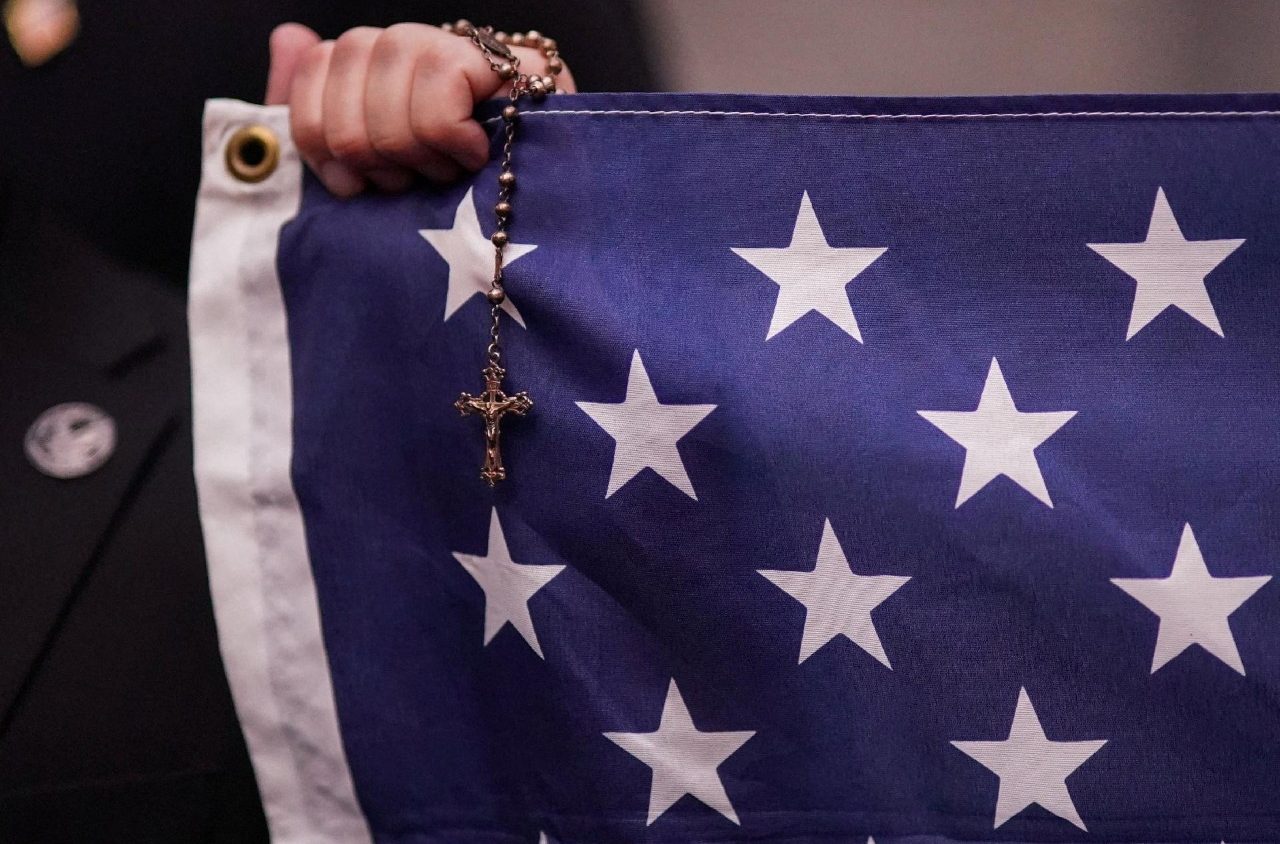

Ahead of the 250th anniversary of the Declaration of Independence, Archbishop William Lori of Baltimore releases a pastoral letter inviting Americans to thank God for their nation while working for political renewal.
By Jenny Kraska – Baltimore
As the United States approaches the 250th anniversary of the Declaration of Independence, the moment invites more than celebration. It calls for discernment. Gratitude for the blessings of a nation must be held alongside an honest recognition of the fractures shaping civic life—not only in America, but across democracies worldwide.
In the pastoral letter In Charity & Truth: Toward a Renewed Political Culture, Archbishop Williamo Lori, Archbishop of Baltimore, points out that today’s political crisis is not merely institutional. It is moral and spiritual.
While laws and structures matter, they cannot substitute for virtue. Renewal beings elsewhere. It begins with a return to Jesus Christ.
The Archbishop insists that authentic political life depends on recovering a clear vision of the human person—created in the image of God, endowed with inviolable dignity, and called into responsibility for others.
Synodality beyond Church structures
A theme of the letter is synodality. Though often discussed in ecclesial terms, the Archbishop suggests its spirit carries lessons for public life as well.
At its heart, synodality is about listening with humility, speaking with honesty, discerning patiently, and walking together rather than retreating into factions. It assumes disagreement. What it rejects is fragmentation.
The Church’s internal life cannot simply be mapped onto secular politics. Yet the habits synodality cultivates—attentiveness patience, moral seriousness, reverence for dignity—are indispensable for any society that hopes to endure pluralism without tearing itself apart.
Recovering a moral imagination
At the heart of the letter is a call to recover what might be called a moral imagination for political life.
This is not naivete. Nor is it a retreat from conviction. Moral imagination is the capacity—formed by virtue—to envision public life where courage does not become aggression, justice does not require humiliation, and truth is not severed from charity.
The Archbishop draws implicitly on the classical and Christian virtues: Prudence, which resists ideological shortcuts; Justice, which seeks the common good rather than mere victory; Fortitude, which endures tension without cruelty; Temperance, which restrains excess in rhetoric and power.
Above all stands charity—not sentiment, but disciplined love of neighbor. Without charity, even true arguments can become instruments of division.
Renewal from among us
Perhaps most striking is the Archbishop’s insistence that renewal will not come from a single leader, movement, or party.
Political culture is shaped by the moral habits of ordinary people. Institutions matter, but they cannot compensate for a deficit of virtue. The change required cannot be imposed; it must be cultivated—through conscience, solidarity, and a renewed commitment to walking together despite disagreement.
In an age tempted by withdrawal on one side and domination on the other, In Charity & Truth: Toward a Renewed Political Culture proposes another path: a politics animated by virtue, sustained by moral imagination, and grounded in the conviction that charity and truth belong together.
For a weary public square, that may be the most radical proposal of all.
