
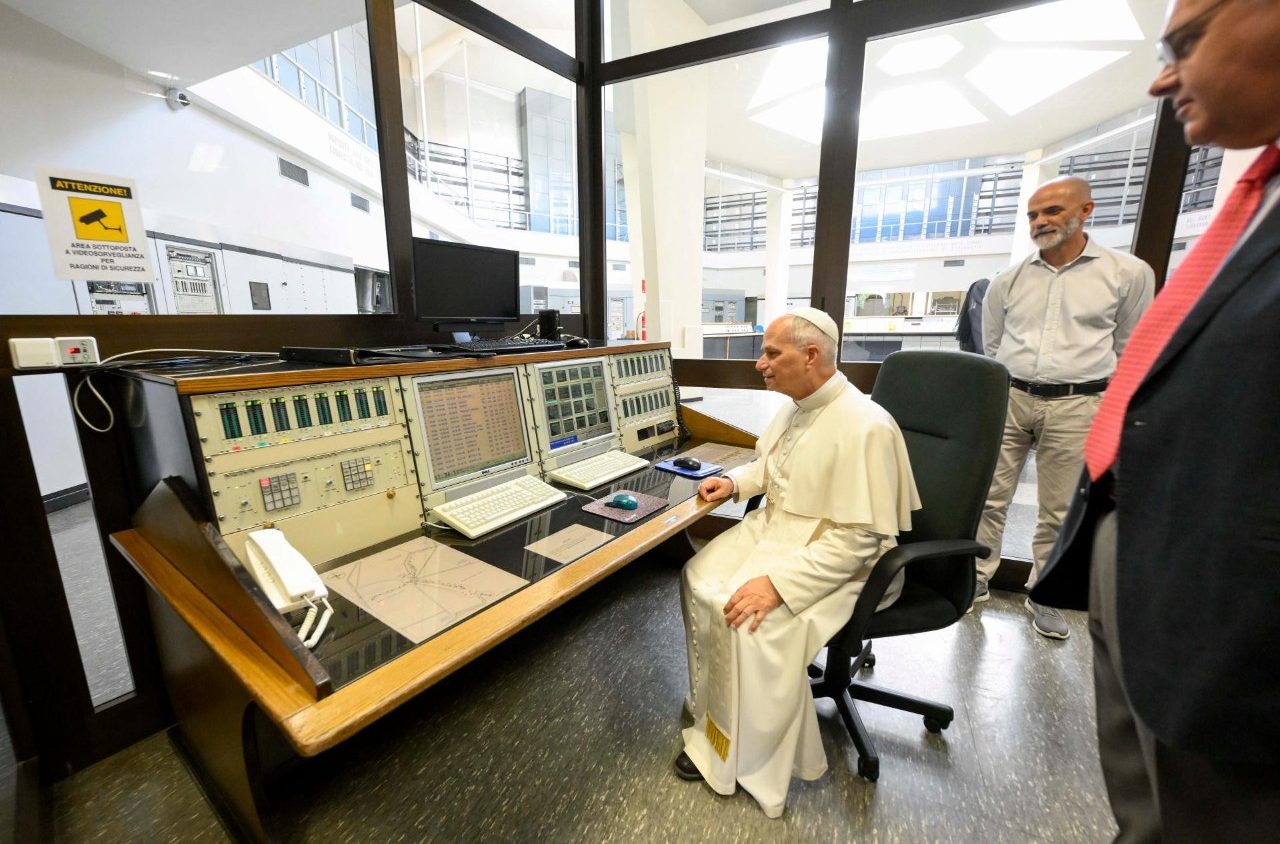

The Director of L’Osservatore Romano, Andrea Monda, reflects on the 95th birthday of Vatican Radio as a key tool of Vatican communications, saying, ‘God favors radio.’
By Andrea Monda
How does the Vatican communicate? By now, everyone knows the answer. It communicates through newspapers, or more specifically, the newspaper L’Osservatore Romano, which has been in print since 1 July 1861.
It communicates through Vatican Radio, which began broadcasting on 12 February 1931. More recently, it also communicates through the Vatican Television Center, now Vatican Media, and through the web, where the Vatican News portal brings all of this together.
Among all Catholic media, radio stands out as the one most closely aligned with the Church’s mission. It is, without a doubt, the most divine. Here is why.
God communicates, indeed, communicates Himself, through Scripture. The written word is essential, but writing comes after speaking. In the beginning, there is the Word. The Word is spoken before it is written. It is only later that it is transcribed.
The Bible and the Gospels, the extraordinary texts in which the Christian faith is grounded, tell stories that first unfolded in real life and were first told aloud. One person speaks, another listens. It is no coincidence that Saint Paul says, “fides ex auditu,” faith comes from hearing. Even earlier, the Old Testament emphasizes listening: “Hear, O Israel!”
In short, God favors radio. He prefers hearing. This makes sense. Sight is powerful, the most effective of the five senses, and one might think it is better.
Yet Saint John reminds us, “No one has ever seen God.” Sight is so strong that it can overwhelm all the other senses. That is why God chooses hearing, perhaps the weakest of the senses. The God of the Bible is gentle. He does not use all His power but moderates it.
What is at stake is human freedom, the gift God gives to every person and respects fully. If God appeared in all His power, what would happen to faith understood as freely accepting Him? Faith is a response to an invitation. God does not impose Himself. He presents Himself quietly, through our ears.
Our ears are always open. It is impossible to close them, so we are naturally listeners. But what do we hear? Many things, perhaps too many. Everything comes in and touches our sensitive eardrums.
What is required is choice, the ability to use our freedom to listen carefully. This is like tuning a radio, finding the right frequency, and catching God’s message among the many voices of the world. It means becoming quiet, turning down the noise of the city, and even the noise of our own hearts.
If God used television, it would be easy. When the TV is on, everyone watches, and life stops. Radio is different. A radio can play while life goes on. Music or news flows quietly in the background until something, an important note or a piece of news, catches our attention. Then we pause everything else and listen. That is how God can reach us.
This is a discreet God who stands at the door and knocks, asking for our attention, a gift we are free to give or refuse. It is a subtle game, one that can shape our lives, a game for attentive ears. In short, even the ear has its role. And it may be the best one.
