
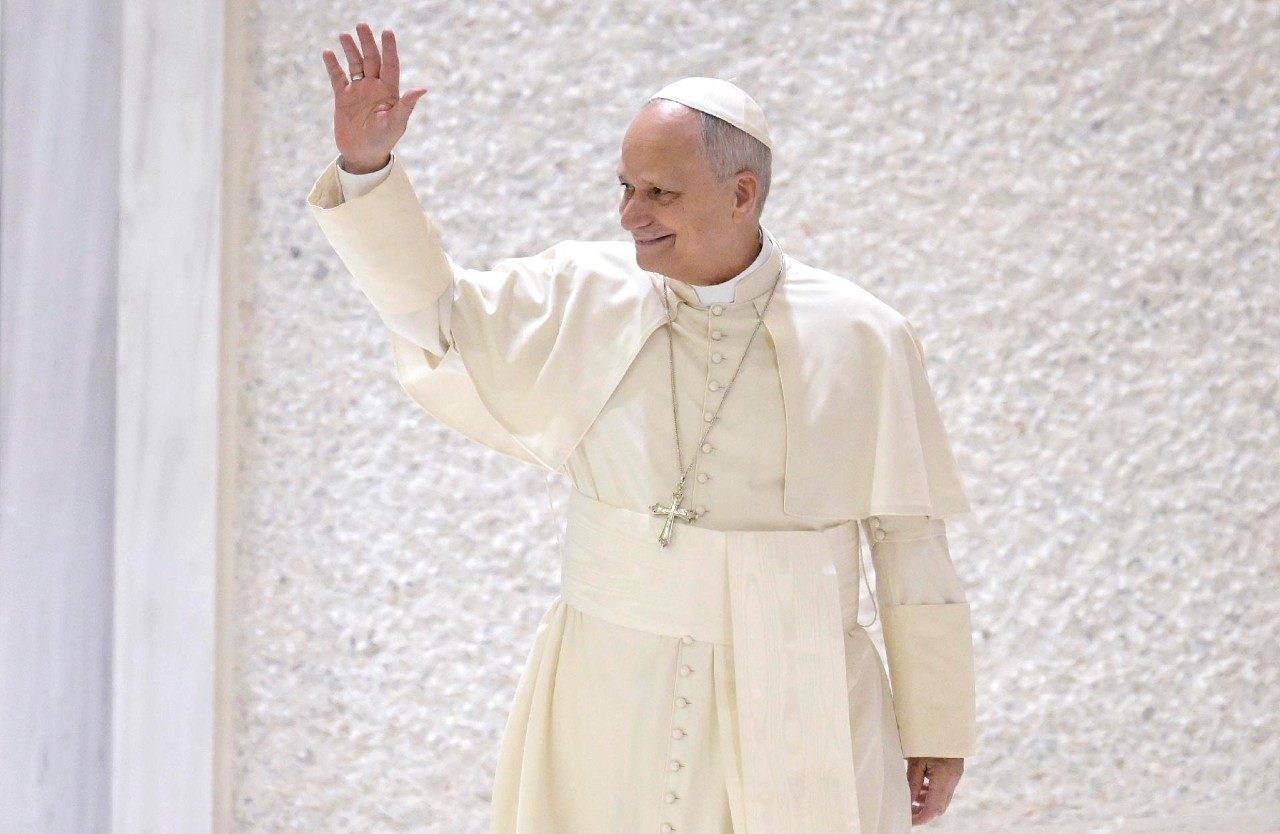

During his weekly General Audience, Pope Leo XIV warns against “fundamentalist or spiritualist readings” of Scripture, and upholds the Church’s mission to proclaim the Word of God in language that touches human hearts.
By Deborah Castellano Lubov
Scripture reveals God’s desire to be close to His people, Pope Leo XIV expressed during his Wednesday General Audience, as he continued his catechesis series on the Second Vatican Council.
He concentrated again this week on the Dogmatic Constitution Dei Verbum on Divine Revelation, which the Pope has called “one of the most beautiful and important” documents of the Council.
The Pope recalled that the Conciliar Constitution indicates that, in Sacred Scripture, the faithful find a “privileged space for encounter where God continues to speak to the men and women of every time, so that, by listening, they can know Him and love Him.”
Accessible, out of God’s great love
The biblical texts, Pope Leo pointed out, “were not written in a heavenly or superhuman language, suggesting that God, out of great love, chooses to speak using human languages, and thus, various authors, inspired by the Holy Spirit, have written the texts of Sacred Scripture.”
Dei Verbum, the Pope said, reiterates that “the words of God, expressed in human language, have been made like human discourse, just as the word of the eternal Father, when He took to Himself the flesh of human weakness, was in every way made like men.”
Therefore, the Holy Father observed, not only in its content, but also in its language, “Scripture reveals God’s merciful condescension towards human beings, and His desire to be close to them.”
Language embodied in human history
The Pope acknowledged that throughout the course of Church history, the relationship between the divine Author and the human authors of the sacred texts has been studied.
“A correct interpretation of the sacred texts can dispense with the historic environment in which they developed and the literary forms that were used,” he said. “On the contrary, to renounce the study of the human words that God used risks leading to fundamentalist or spiritualist readings of Scripture, which betray its meaning.”
He also noted this principle also applies to the proclamation of the Word of God.
“If it loses touch with reality, with human hopes and sufferings, if an incomprehensible language is used, or if it is uncommunicative or anachronistic,” Pope Leo warned, “it is ineffective.”
Moreover, he reaffirmed, “In every age, the Church is called to repropose the Word of God in a language capable of being embodied in history and reaching hearts.”
Especially when proclaimed in the context of the liturgy, the Pope insisted, “Scripture is intended to speak to today’s believers, to touch their present lives with their problems, to enlighten the steps to be taken and the decisions to be made.”
Joyful proclamation of full life God has given to us
“Scripture,” the Pope stated, “serves to nurture the life and charity of believers.”
He reiterated that the divine origin of the Scripture also recalls that the Gospel, entrusted to the witness of the baptized, despite embracing all the dimensions of life and reality, transcends them.
Scripture, Pope Leo stressed, “cannot be reduced to a mere philanthropic or social message, but is the joyful proclamation of the full and eternal life that God has given to us in Jesus.”
Finally, Pope Leo concluded by urging the faithful to “thank the Lord because, in His goodness, He ensures our lives do not lack the essential nourishment of His Word, and let us pray that our words, and even more so our lives, do not obscure the love of God that is narrated in them.”
