
Pope Leo tells Rome’s young people not to be content with superficial relationships, but to seek the truth, goodness and communion that arise from encountering God and one’s neighbour.
By Thulio Fonseca
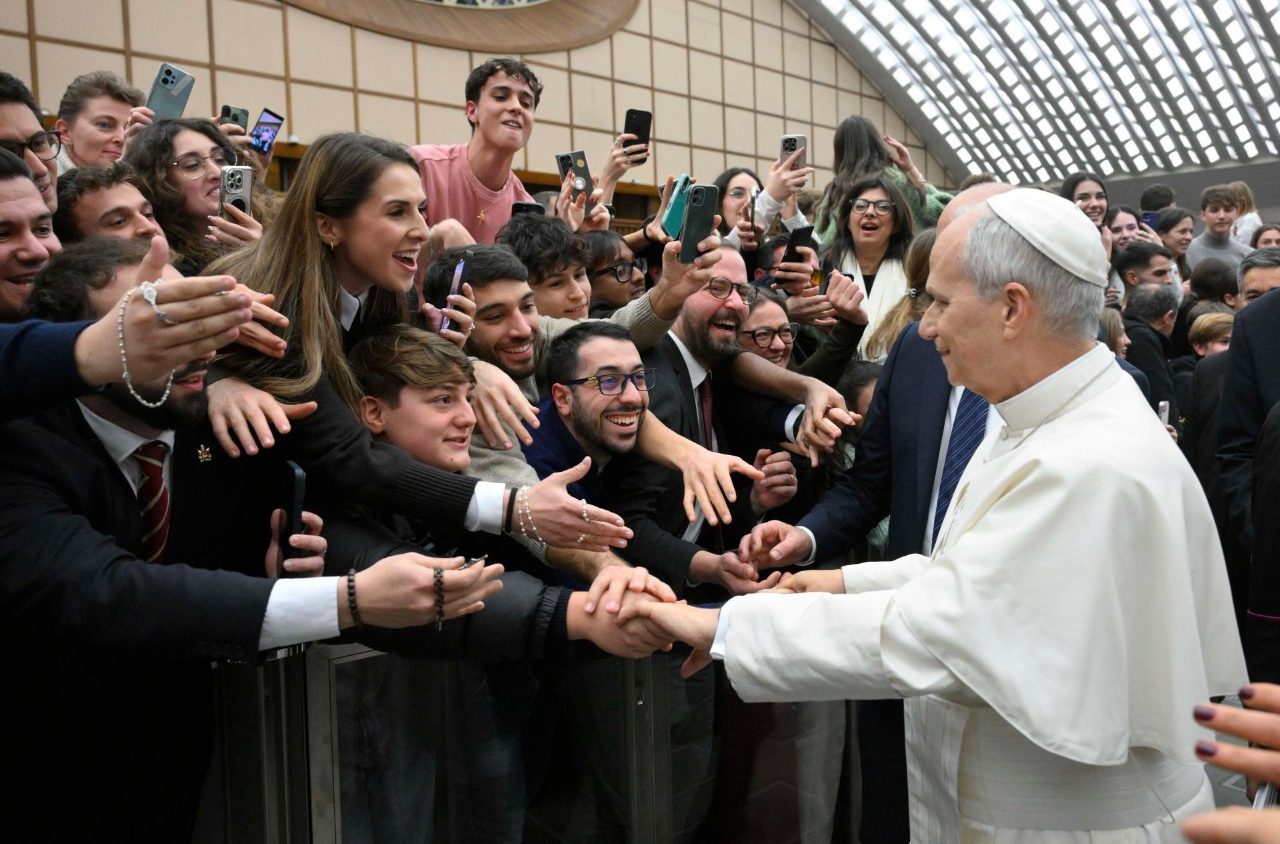
Upon arriving in the Vatican’s Paul VI Hall, Pope Leo XIV was enthusiastically welcomed by the young people of the Diocese of Rome, who greeted him warmly and offered him a moving embrace.
The meeting, held this Saturday, January 10, just days after the conclusion of the Jubilee Year, brought together thousands of young people—accompanied by priests, religious, and educators—both inside and outside the Paul VI Hall.
Pope Leo said that shortly before the meeting he had received a message from his niece, asking how he manages to face so many of the world’s problems and whether he ever feels alone. The answer, the Pope said, was found in the large crowd of young people in front of him.

Pope Leo greets some of the young people in St Paul VI Hall (@VATICAN MEDIA)
Hidden loneliness in the virtual world
Pope Leo did not ignore the unease that many young people suffer: loneliness, disorientation, and boredom, even amid crowds and constant stimulation.
“When this grayness dulls the colors of life, we see that it is possible to be isolated even in the midst of many people,” he said.
According to the Pope, loneliness shows its face when “one is not listened to, because one is immersed in the noise of opinions,” and when “one looks at nothing, because one is dazzled by fragmented images.”
A light that never goes out
Pope Leo also spoke of poetry, evoking verses by Salvatore Quasimodo that speak of human loneliness, but reinterpreted them in the light of faith. The “ray” that pierces the heart, he explained, is not a passing light: “it is not a flickering light that rises only to set again, but the Sun of justice, who is Christ.” And he added: “He warms our hearts and sets them ablaze with his love.”
From this encounter with Jesus, the Pope said, comes the strength to change one’s own life and to transform society. “The light of the Gospel illuminates our relationships,” spreading through everyday words and gestures, until it turns “a gray and anonymous world into a welcoming place, shaped to the human person, precisely because it is inhabited by God.”
Bearing witness without seeking applause
The Holy Father expressed joy at the authentic experiences young people live in parishes, oratories, and charities, but he warned them not to expect easy recognition. “Do not expect the world to welcome you with open arms,” he said, recalling that “advertising, which needs to sell something to be consumed, attracts more attention than witness, which seeks to build sincere friendships.”
Pope Leo therefore urged the young people to “act with joy and perseverance, knowing that to change society we must first change ourselves.”
Prayer breaks the chains
Responding to the young people’s desire to know what they can do concretely to break the “chains” that bind them, Leo XIV was clear: “First of all, pray.” He defined prayer as a deeply real and transformative act: “It is the most concrete act a Christian performs for the good of those around them, for themselves, and for the whole world.”
Prayer, the Pope explained, “is an act of freedom that breaks the chains of boredom, pride, and indifference.”
It is God, Pope Leo said, who kindles the fire of a burning heart, especially when Christians encounter Him in the Eucharist, in the Gospel, and in the Psalms, enabling them to become “the light of the world and the salt of the earth.”
