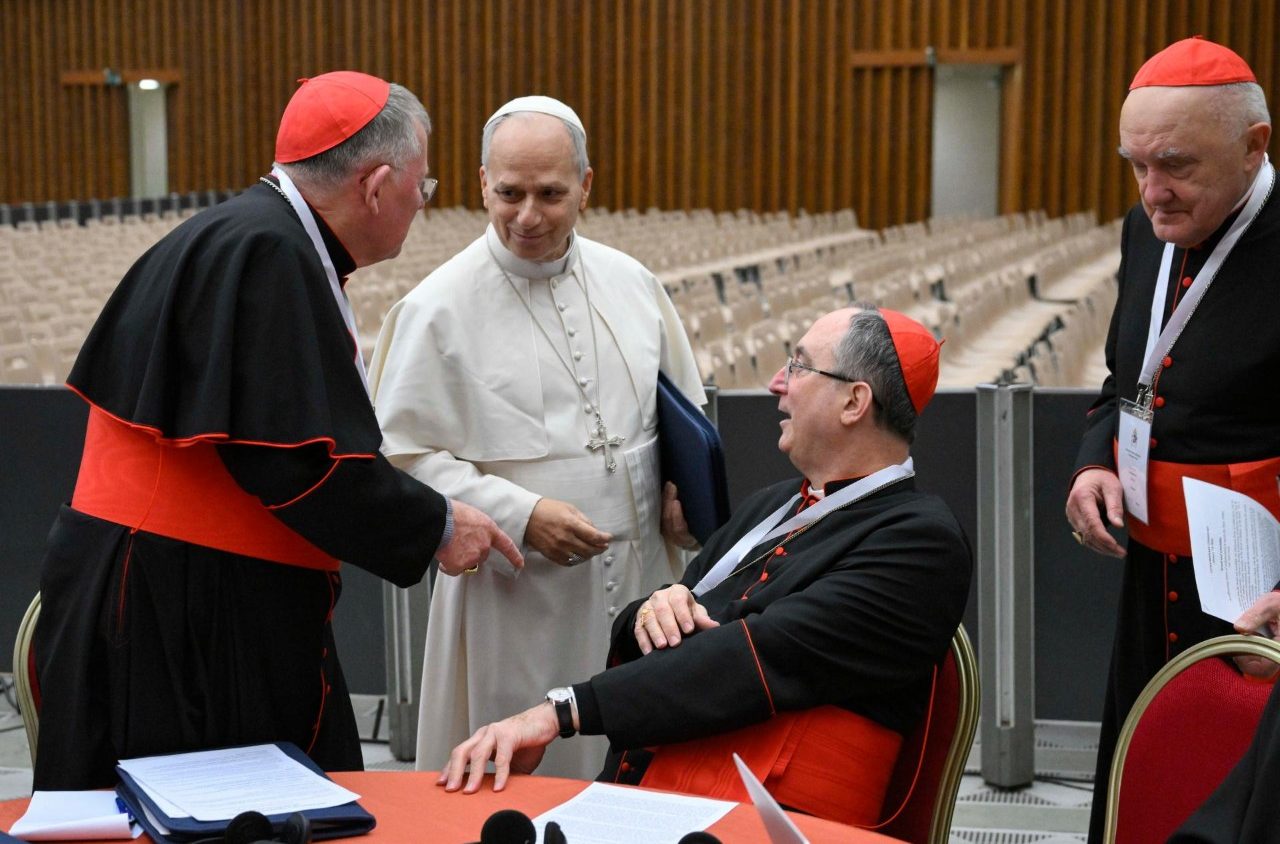

At the end of the second day of the Extraordinary Consistory, Pope Leo XIV expressed his desire to continue along this path, “in continuity” with what was requested in the pre-Conclave general congregations, and confirmed the Ecclesial Assembly of October 2028. Cardinal Brislin of South Africa, Cardinal David of the Philippines, and Cardinal Rueda Aparicio of Colombia describe the morning and afternoon proceedings, noting there was a sense of unity, even if not uniformity.
By Salvatore Cernuzio
The first has ended this evening, but the next appointment is already set: two days in June, close to the Solemnity of Saints Peter and Paul. A new extraordinary Consistory awaits Pope Leo XIV and the Cardinals from all over the world in the Vatican.
It was the Holy Father himself who announced this second summer meeting in his concluding address at the third and final session this afternoon, which brought together 170 Cardinals, electors and non-electors.
The Pope—explaining that this two-day meeting is “in continuity” with what was requested of the general congregations before the Conclave—also expressed his wish to continue holding Consistories on an annual basis, lasting three to four days. He had already anticipated this in yesterday’s address, stating that this Consistory is a “prefiguration of our future journey.”
He also confirmed the Ecclesial Assembly of October 2028 announced last March.
Thanks to those present and closeness to those absent
In addition to the announcements, Pope Leo XIV wished to thank those present for their participation and support. He offered a particular word of thanks to the more elderly Cardinals for the effort of coming.
“Your witness is precious,” he said, as he likewise expressed his closeness to the Cardinals throughout the world who were unable to be in Rome these days, noting, “We are with you and close to you.”
A “non-technical synodality,” Pope Leo said that he experienced over yesterday and today—a deep harmony and communion—made possible by a methodology chosen to foster better mutual knowledge, given the diversity of backgrounds and experiences of each. From this followed a reference to the Second Vatican Council, the foundation of the Church’s path and renewal, and also the clarification that the other two topics proposed and not voted on yesterday by the assembly—the liturgy and Praedicate evangelium—are closely connected to the Council and must not be forgotten.
Finally, both on the part of the Pope and of all the members of the College of Cardinals, there was an attentive gaze toward the overall situation of the world, which makes a response by the Church “all the more urgent.” A Church that draws near to the local Churches suffering wars and violence.
A thought for Venezuela
Along these lines, even though the themes of the Consistory were quite different—synodality and mission in the light of Evangelii gaudium, approved yesterday by a majority vote of the Cardinals—there was nevertheless a particular thought, especially from Latin American Cardinals, for the situation in Venezuela.
This was voiced by Cardinal Luis José Rueda Aparicio, Archbishop of Bogotá in Colombia, during an evening press conference which also featured the voices of Cardinal Stephen Brislin, Archbishop of Johannesburg in South Africa, and Cardinal Pablo David, Bishop of Kalookan in the Philippines.
The Colombian Cardinal recalled the Pope’s words at the Angelus on 4 January, the day after the dramatic events, in which Pope Leo XIV “expressed his profound concern for what is happening in Venezuela and committed himself to encouraging dialogue and the search for consensus, invoking peace, to build a peace that is at once unarmed and disarming, that seeks to unite peoples in respect for human rights and sovereignty.”
“That Sunday message set the tone for my reflections during these days,” Cardinal Rueda stated. It was not the official theme of the Consistory, but it was “inevitable” that the members of the College of Cardinals “be concerned about what is happening,” that they be “asking themselves questions” about the direction being taken, about how the geopolitics of Latin America are changing, and how the Church can accompany the population. Venezuela is an issue that “we carry in our hearts, it grieves us all, and we desire the best possible developments in the near future,” Cardinal Rueda said.
Living synodality as “companions on the journey”
The three Cardinal speakers then reported on the themes and the general atmosphere that emerged during the proceedings, which began in the morning and continued in the afternoon, punctuated also by moments of song and prayer, with a lunch break in the atrium of the Paul VI Hall.
They explained that the Pope was present and gave each participant the medal of his pontificate.
The language groups’ focus, they relayed, was greatly centered upon synodality, the need to live it as “companions on the journey,” that it be reflected in the exercise of authority, in formation and in the work of nuncios, that it be lived in the Curia with “greater internationalization,” and then a rereading of Pope Francis’s exhortation Evangelii gaudium—a text that has not “expired” with the previous pontificate but continues to challenge dioceses, the Roman Curia, and the Pope himself.
There were twenty groups: eleven including non-elector Cardinals, and nine including elector Cardinals—diocesan ordinaries and nuncios still in service—explained the Director of the Holy See Press Office, Matteo Bruni.
“The Pope was taking notes, he was very attentive”
For his part, Cardinal Brislin described the experience as “very enriching,” thanks to the different perspectives that made it possible to deepen an understanding of the needs of the world—thus an opportunity to know and to come to know one another. He said that the fact that there will be a new meeting in June is a sign that the Holy Father has taken very seriously the fact that we can help him in his role as Successor of Peter.
“Eight months after the Conclave the Pope wanted to convene us to listen to us,” Cardinal Rueda echoed. This “strengthens us in the mission of the Church.” Joking instead about jet lag (“I can’t believe I’m still here; today we started very early at 7”) and about the beautiful setting of the Consistory, Cardinal David first praised the format used for the proceedings, then the conversation in the Spirit through which “everyone was able to speak,” and he appreciated the fact that the Pope “listened more than he spoke”: “He was taking notes, he was very attentive; the input he gave was very enriching for all of us.”
The importance of getting to know one another
A journalist then asked what the truly new elements that emerged from this Consistory might be, given that many of the themes listed have already been extensively explored during the two sessions of the Synod on Synodality.
In response, Cardinal Brislin explained that the novelty should not be sought “only in the discussions” but rather in the very “opportunity to get to know one another and to listen to one another.”
“This is important,” he said, “because we come from different parts of the world; some are new Cardinals, others have been Cardinals for a long time.”
The Pope, added the Archbishop of Johannesburg, “wants to be collegial, he wants to listen, he wants to draw on the experience and knowledge of the Cardinals who come from different parts of the world, because this can help him to guide the Church.” The profiles are “different,” but the work was carried out “in a harmony that is not uniformity,” Cardinal Rueda concluded.
Laity and women
Still on the themes, journalists also asked whether the question of the participation of the laity and the role of women in the Church had in some way entered into the discussions.
On this point, Cardinal David said, “How can we not recognize the role of women and their ministries in the Church?” “Certainly,” the Filipino Cardinal stated, the question of women is “a constant concern,” recalling the results—recently published—of the Commission for the Study of the Female Diaconate. Cardinal David also made reference to “clericalism” and relaunched the idea of the “priesthood” of the people drawn from the Second Vatican Council.
“We speak of the Body of the Church: we have the Head of the Church, but not only the Head; there is also a Body. People have the power to participate in the life and mission of the Church.”
About the Author