
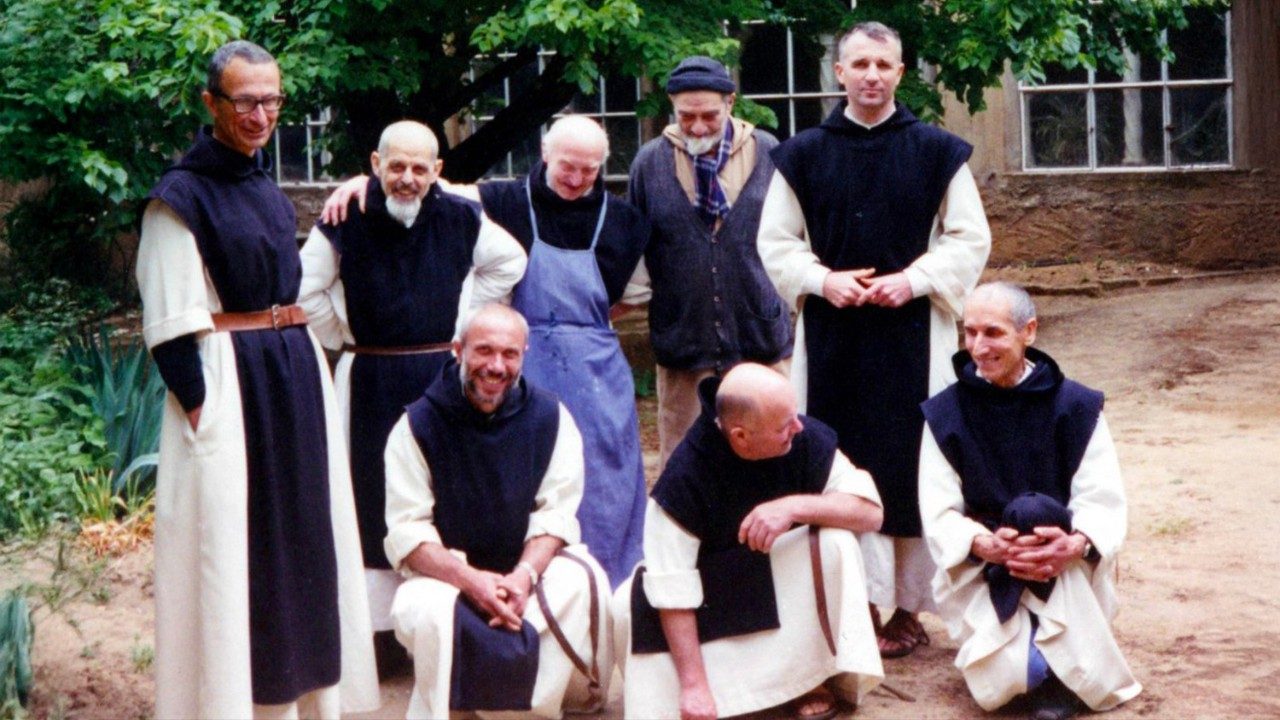
On March 26, 1996, seven Trappist monks in Tibhirine were kidnapped and killed in the midst of Algeria’s “Black Decade.” Today, the Trappists have left the monastery—managed for the past ten years by the Chemin Neuf Community—but the monks’ spirit of prayer and fraternity remains very much alive there.
By Olivier Bonnel
During the night of March 26–27, 1996, the seven Trappist monks of the Tibhirine monastery in Algeria were abducted by armed men. Their heads were discovered on May 30, a few days after a statement by the Armed Islamic Group (GIA) announced their death by beheading.
The murder of the Cistercian monks of the Abbey of Notre-Dame de l’Atlas sent shockwaves throughout the country and beyond. In 2010, the film Of Gods and Men by Xavier Beauvois won the Grand Jury Prize at the Cannes Film Festival, bringing global attention to the lives of these brothers.
In 1996, Algeria was in the midst of the “Black Decade,” marked by terrorist attacks carried out by various Islamist groups and by armed repression—a dark chapter that claimed tens of thousands of victims among the Algerian people.
Despite the threats, the monks of Tibhirine remained firm in their decision to stay at monastery, convinced that their quiet, prayerful presence in a Muslim land was where God had led them.
“If one day it should happen to me—and it could be today—to become a victim of the terrorism that now seems to be targeting all foreigners living in Algeria, I would like my community, my Church, my family to remember that my life was given to God and to this country,” wrote Christian de Chergé, the prior of the monastery, in a testamentary letter found by his brother the day after his death was announced.
Rooted in Algerian soil
Brother Christian, along with Brother Luc—who treated local residents in the dispensary at the monastery entrance—Brother Michel, the community’s cook and gardener, as well as Brother Célestin the cantor, Brother Christophe, Brother Bruno, and Brother Paul, all embodied a community living in peace and serving the poor.
Their gentle presence stood out even more starkly as violence raged around them. Over time, as they became deeply rooted in Algerian soil, they formed strong friendships with the local people, and their lives became an important chapter in the history of dialogue with Islam.
“I remember Brother Christian’s bare feet in his rope sandals when he opened the gate,” recalled journalist François Vayne, born in Algeria, who spent 17 years in the country and was familiar with the monastery. “In those sandals, I sensed the gift of his life for others.”

A view of the Tibhirine Monastery
The legacy of the seven Trappists is immeasurable. Along with twelve other martyrs—including Bishop Pierre Claverie of Oran, who was assassinated a few weeks later along with his Muslim driver—the monks were beatified on December 8, 2018, by Pope Francis.
Although the monks’ bodies were never found, a small cemetery with seven steles (grave markers) has been erected in the garden near the monastery. Around the world, memorials commemorate the monks’ sacrifice—from Norway to the United States, and from the Democratic Republic of the Congo to Cameroon.
The monks’ spiritual legacy
In Tibhirine, the spirit of the monks still lives on. Although the Cistercian community of Notre-Dame de l’Atlas relocated to Morocco, the Algerian site was first preserved—first in 2001 by Father Jean-Marie Lassausse, a priest of the Mission de France who came there under police protection. The monastery’s orchard and vegetable garden have been cared for with the help of Samir and Youssef, friends of Brother Christophe.
In 2016, the Archbishop of Algiers entrusted the Chemin Neuf Community with the responsibility of preserving the vitality of the site. Many pilgrims come to Tibhirine—most of them Algerians—and are welcomed. On site, the spirit of the monks endures, marked by silence, peace, and fraternity, as testified by Father Eugène Lehembre, who is responsible for the community there.
